
Quay lại danh sách
#76Tập 1

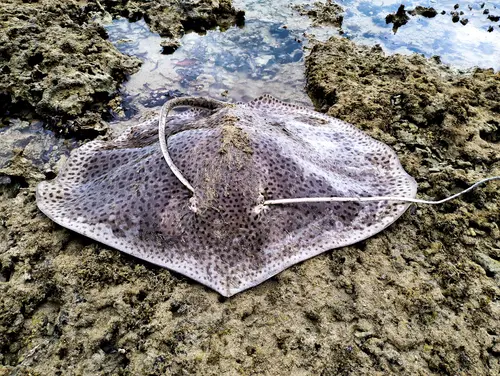
Cá Đuối bồng gai

Himantura uarnak (Forskal) 1775

WoRMS — Tên hợp lệ trên WoRMS
Tên được xác nhận
Xem trên WoRMS (marinespecies.org)

Thông tin chính

Tên gọi khác
Cá Đuối bồng gai
Common Name (EN)
Honeycomb stingray
Kích thước
Thường gặp 141 - 190 cm, lớn nhất 200 cm.
Size
Ordinary 141 - 190 cm, maximum 200 cm.

Phân bố

Ấn Độ Dương, Indonesia, Australia, Philippines, Trung Quốc, Việt Nam. Vịnh Bắc Bộ.

Mẫu vật & Tài liệu

Nơi lưu trữ mẫu
Viện Hải sản Hải Phòng.
Specimen
Haiphong Resarch Institute of Marine Products (printed as Resarch).
Tình trạng
Thường gặp, số lượng nhiều.
Status
Common, abundant.
Tài liệu dẫn
Herre, 1953, Chu Nguyên Đinh, 1962. Nguyễn Khắc Hường, 1992.
Literature
Herre, 1953, Chu, 1962. Nguyen Khac Huong, 1992.

Sinh học — Sinh thái BIO

Tên tiếng Anh (FishBase)
Honeycomb stingray
English name (FishBase)
Honeycomb stingray
Chiều dài tối đa
200.0 cm WD
Max length
200.0 cm WD
Trọng lượng tối đa
150,000 g
Max weight
150,000 g
Độ sâu phân bố
20 - 50 m
Depth range
20 - 50 m
Môi trường sống
Neritic, Estuaries, Mangroves, Coral reefs, Benthic, Soft bottom, Mud
Habitat
Neritic, Estuaries, Mangroves, Coral reefs, Benthic, Soft bottom, Mud
Sách Đỏ IUCN
EN
IUCN Red List
EN
Nguy hiểm cho người
Gây thương tích cơ học
Danger to humans
traumatogenic
Kiểu ăn
Săn mồi lớn (ăn thịt)
Feeding type
hunting macrofauna (predator)
Bậc dinh dưỡng
3.60
Trophic level
3.60
Hình thức sinh sản
Phân giới tính, thụ tinh trong (ống dẫn trứng)
Reproduction
dioecism, internal (oviduct) fertilization
Giá trị thương mại
Thương mại nhỏ
Importance
minor commercial
Nuôi trồng thủy sản
Không/hiếm khi
Aquaculture
never/rarely

Ghi chú chi tiết

Tóm tắt sinh học (FishBase)(Biology summary (FishBase))

Loài này thường xuất hiện ngoài khơi các bãi biển cát, trong các cửa sông và đầm phá nông; cũng được tìm thấy tại các khu vực đáy cát của rạn san hô (Ref. 9710). Ngoài ra, chúng còn phân bố ở vùng biển khơi với độ sâu lên đến 50 m (Ref. 5578) và có khả năng di cư vào vùng nước ngọt (Ref. 5578). Thức ăn chủ yếu bao gồm cá nhỏ, động vật hai mảnh vỏ, cua, tôm, giun (Ref. 3263) và sứa (Ref. 37816). Loài này sinh sản theo hình thức noãn thai sinh (Ref. 50449). Đây là đối tượng khai thác phổ biến bằng lưới bén tầng đáy, lưới kéo đáy, câu vàng và lưới vây bãi biển (Ref. 58048). Loài này thường được câu giải trí (Ref. 3263) nhưng không được đánh giá cao về giá trị thực phẩm (Ref. 3263). Trong y học cổ truyền Trung Quốc, loài này được sử dụng làm dược liệu (Ref. 12166). Phần đuôi thường bị ký sinh bởi các loài sán đơn chủ Dendromonocotyle colorni và Dendromonocotyle ukuthena trên bề mặt da lưng (Ref. 124058).

Xem văn bản gốc tiếng Anh (FishBase / GBIF)

Common off sandy beaches and in shallow estuaries and lagoons; also found in sandy areas of coral reefs (Ref. 9710). Also offshore down to 50 m depth (Ref. 5578). May enter fresh water (Ref. 5578). Feeds on small fishes, bivalves, crabs, shrimps, worms (Ref. 3263) and jellyfishes (Ref. 37816). Ovoviviparous (Ref. 50449). Common catch of the demersal tangle net, bottom trawl, longline and beach seine fisheries (Ref.58048). Popular angling fish (Ref. 3263). Not esteemed as a food fish (Ref. 3263). Used in Chinese medicine (Ref. 12166). Tail is used as It is parasitised by the monogeneans <i>Dendromonocotyle colorni</i> and <i>Dendromonocotyle ukuthena</i> on the dorsal skin surface (Ref. 124058).

Ghi chú sinh thái(Ecology notes)

Loài có khả năng chịu đựng độ mặn rất thấp và là loài rộng muối (euryhaline). Chúng chuyên ăn các sinh vật tầng đáy khi nằm vùi trên nền đáy (Ref. 9773). Thường được tìm thấy trên nền đáy cát hoặc bùn (Ref. 127989, 129713). Phân bố phổ biến ngoài khơi các bãi biển cát, trong các cửa sông và đầm phá nông; cũng xuất hiện tại các khu vực đáy cát của rạn san hô (Ref. 9710, 9773). Loài này sinh sống trên thềm lục địa (Ref. 75154), ở vùng biển khơi với độ sâu tới 50 m (Ref. 5578) và có thể xâm nhập vào môi trường nước ngọt (Ref. 5578). Thức ăn bao gồm cá nhỏ, động vật hai mảnh vỏ, cua, tôm và giun.

Xem văn bản gốc tiếng Anh (FishBase / GBIF)

Tolerates very low salinities. Feeds on benthic organisms at lies on the seabed (Ref. 9773). Euryhaline species. Found in sandy or muddy substrates (Refs. 127989, 129713). Common off sandy beaches and in shallow estuaries and lagoons; also found in sandy areas of coral reefs (Refs. 9710, 9773). Found on the continental shelf (Ref. 75154). Also offshore down to 50 m depth (Ref. 5578). May enter fresh water (Ref. 5578). Feeds on small fishes, bivalves, crabs, shrimps and worms.

Ghi chú sinh sản(Reproduction notes)

Loài thể hiện hình thức noãn thai sinh (đẻ con không qua nhau thai), trong đó phôi ban đầu hấp thụ noãn hoàng, sau đó nhận thêm dưỡng chất từ mẹ thông qua việc hấp thụ gián tiếp dịch tử cung giàu chất nhầy, chất béo hoặc protein nhờ các cấu trúc chuyên biệt (Ref. 50449). Có tập tính ghép đôi đặc trưng với hành vi ôm ấp (Ref. 205). Mỗi lứa đẻ từ 3 đến 5 con vào mùa hè (Ref. 5578). Kích thước khi mới sinh đạt khoảng 21 cm (Ref. 58048) đến 28 cm chiều rộng đĩa (WD) (Ref. 6871).

Xem văn bản gốc tiếng Anh (FishBase / GBIF)

Exhibit ovoviparity (aplacental viviparity), with embryos feeding initially on yolk, then receiving additional nourishment from the mother by indirect absorption of uterine fluid enriched with mucus, fat or protein through specialised structures (Ref. 50449). Distinct pairing with embrace (Ref. 205). Distinct pairing with embrace (Ref. 205). Bears 3 to 5 young in the summer (Ref. 5578). Size at birth about 21 (Ref.58048) - 28 cm WD (Ref. 6871).

Danh pháp đồng nghĩa & Phân loại gốc

Himantura Mullar and Henle, Archiv. Naturges., p. 400, 1837 (printed as Mullar and Henler). Type : Raja uarnak Forskal.
Raja uarnak Forskal, Descript. Animals, pp. VIII and 18, 1775.
Raja arnak Forskal, Descript. Animals, pp. IX, 1775.
Raia uarnac Cuvier, Regne Animal, Vol. 2, p. 136, 1817.
Trygonobatus russelli Gray, Illustrations Indian Zoology, Vol. 2, pl. 100, 1832 - 34.
Pastinachus narnak Ruppell, Neue Werbelt., Fische Rothen Meeres, p. 69, pl. 19, figs 2, 1835 (printed as narnak).
Trygon uarnak Muller and Henle, Plagiost., p. 158, 1841. Cantor, 1849. Gray, 1851. Bleeler, 1852 (printed as Bleeler). Gunther, 1870. Day, 1878. Weber, 1913. Tirant, 1929.
Trygon variegatus Mc Clelland, Calcutta Jour. Nat. Hist., Vol. 1, p. 60, pl. 2, fig.2, 1841.
Trygon uarnack Richardson, Ichth. China and Japan, p. 197, 1846 (printed as uarnack).
Trygon uarnacoides Bleeker, Verh. Bat. Gen., Vol. 23, p. 13, 1850. Bleeker, 1852.
Trygon pastinacoides Bleeker, Verh. Bat. Gen., Vol. 24, Plagiost., p. 75, 1852.
Trygon undulata Bleeker, Verh. Bat. Gen., Vol. 24, Plagiost., p. 70, 1852.
Trygon pareh Bleeker, Verh. Bat. Gen., Vol. 24, Plagiost., p. 71, 1852.
Trygon russelli Blyth, Jour. Asiatic Soc. Bengal, Vol. 29, p. 42, 1860.
Trygon ellioti Blyth, Jour. Asiatic Soc. Bengal, Vol. 29, p. 41, 1860.
Leiobatus (Himantura) uarnak Bleeker, Ned. Tijds. Dierk., Vol. 1, p. 264, 1863.
Trygon (Himantura) warnak Dumeril, Hist. Nat. Elasmobr., Vol. 1, p. 585, 1865 (printed as warnak).
Trygon (Himantura) variegatus Dumeril, Hist. Nat. Elasmobr., Vol. 1, p. 587, 1865.
Trygon (Himantura) udulatus Dumeril, Hist. Nat. Elasmobr., Vol. 1, p. 586, 1865 (printed as udulatus).
Trygon punctata Gunther, Cat. Fishes British Mus., Vol. 8, p. 474, 1870.
Trygon (Himantura) oxyrhynchus Sauvage, Bull. Soc. Philom. Paris, Ser. 7, Vol. 2, p. 94, 1878.
Himantura uarnak Sauvage, in Grandidier, Hist. Phys. Nat. Madagascar, Poissons, p. 510, 1891. Jordan and Richardson, 1908.
Himantura Gerrardi (not of Gray) Tosh, Marine Biol. Rep. Queensland, p. 4, pl. 5, fig. 2, 1903 (printed as Gerrardi).
Dasyatis russellii Fowler, Jour. Acad. Sci. Phila., Ser. 2, Vol. 12, p. 499, 1904 (printed as russellii).
Dasyatis uarnak Stead, Additions fish fauna New South Wales, Vol. 1, p. 2, 1907. Fowler, 1927. Wang, 1933.
Dasybatis uarnak Regan, Ann. Natal Mus., Vol. 1, p. 242, 1908.
Dasybatis uarnak Garman, Mem. Mus. Comp. Zool., Vol. 36, p. 376, 1913.
Dasybatus (Himanturus) uarnak Chabanaud, Service Oceanogr. Peches Indo-Chine, 1e Note, p. 6, 1926.
Himantura arnak Mc. Culloch, Mem. Australian Mus., Vol. 5, p. 29, 1929.
Dasyatis uaranak Fowler, Jour. Nat. Hist. Soc. Bombay, Vol. 33, p. 101, 1928 (printed as uaranak).