
Quay lại danh sách
#18Tập 3

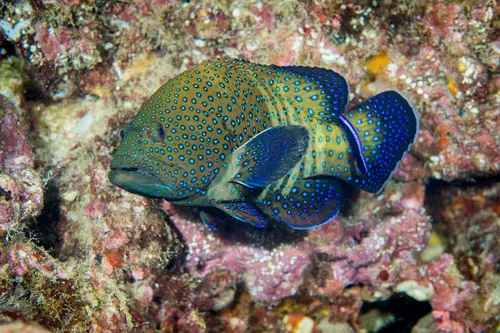
Cá Mú chấm nâu

Cephalopholis argus Bloch and Schneider, 1801

WoRMS — Tên hợp lệ trên WoRMS
Tên được xác nhận
Xem trên WoRMS (marinespecies.org)

Thông tin chính

Tên gọi khác
Cá Mú bịp
Common Name (EN)
Blue-spotted grouper, Peacock grouper
Kích thước
43 cm.
Size
43 cm.

Phân bố

Australia, Ấn Độ, Singapore, Indonesia, New Guinea, Madagascar, Philippines, Trung Quốc, Việt Nam. Vịnh Bắc Bộ, Miền Trung, Nam Bộ.

Mẫu vật & Tài liệu

Nơi lưu trữ mẫu
Viện Hải dương học (Nha Trang).
Specimen
Institute of Oceanography (Nhatrang).
Tình trạng
Thường gặp, số lượng nhiều.
Status
Common, numerous.
Tài liệu dẫn
Weber and de Beaufort, 1931. Herre, 1953. Orsi, 1974.
Literature
Weber and de Beaufort, 1931. Herre, 1953. Orsi, 1974.

Sinh học — Sinh thái BIO

Tên tiếng Anh (FishBase)
Peacock hind
English name (FishBase)
Peacock hind
Chiều dài tối đa
60.0 cm TL
Max length
60.0 cm TL
Độ sâu phân bố
0 - 40 m
Depth range
0 - 40 m
Môi trường sống
Neritic, Coral reefs, Benthic, Soft bottom, Mud, Rocky
Habitat
Neritic, Coral reefs, Benthic, Soft bottom, Mud, Rocky
Sách Đỏ IUCN
LC
IUCN Red List
LC
Nguy hiểm cho người
reports of ciguatera poisoning
Danger to humans
reports of ciguatera poisoning
Kiểu ăn
Săn mồi lớn (ăn thịt)
Feeding type
hunting macrofauna (predator)
Bậc dinh dưỡng
4.48
Trophic level
4.48
Hình thức sinh sản
protogyny, external fertilization
Reproduction
protogyny, external fertilization
Tập hợp sinh sản
Có — tập hợp sinh sản theo đàn
Spawn aggregation
Yes — forms spawning aggregations
Giá trị thương mại
Thương mại
Importance
commercial
Nuôi trồng thủy sản
Không/hiếm khi
Aquaculture
never/rarely

Ghi chú chi tiết

Tóm tắt sinh học (FishBase)(Biology summary (FishBase))

Đây là loài cá phổ biến (Ref. 9710). Cá trưởng thành sống ở tầng đáy và tầng trung - đáy tại nhiều môi trường rạn san hô khác nhau (Ref. 58534, 58302), từ các vũng triều đến độ sâu ít nhất 40 m; chúng ưa thích vùng rạn san hô có độ sâu từ 1 đến 10 m. Cá con thường trú ngụ tại các bụi san hô nông và kín gió (Ref. 37816). Cá trưởng thành sống theo đơn vị xã hội gồm tối đa 12 cá thể, bao gồm một con đực chiếm ưu thế. Mỗi nhóm chiếm giữ một khu vực cụ thể (lên đến 2.000 m2), được bảo vệ bởi con đực lãnh thổ và chia thành các lãnh thổ phụ, mỗi lãnh thổ phụ là nơi cư trú của một con cái (Ref. 39231). Đôi khi, chúng cũng sống đơn độc (Ref. 90102). Thức ăn của cá trưởng thành chủ yếu là cá (chiếm 75-95%) và một phần nhỏ là giáp xác. Tại Biển Đỏ, chúng kiếm ăn vào sáng sớm và chiều muộn (Ref. 6775), trong khi tại Madagascar, chúng có xu hướng kiếm ăn nhiều hơn vào ban đêm (Ref. 6774). Loài này có liên quan đến các trường hợp ngộ độc ciguatera tại một số đảo ở khu vực Thái Bình Dương. Chúng thường xuất hiện tại các chợ cá sống ở Hồng Kông (Ref. 27253). Đây là đối tượng quan trọng trong nghề cá thủ công trên khắp khu vực Ấn Độ Dương - Tây Thái Bình Dương, thường bị đánh bắt bằng câu, lao xiên và bẫy (Ref. 39231). Độ sâu tối thiểu được ghi nhận từ Ref. 128797.

Xem văn bản gốc tiếng Anh (FishBase / GBIF)

A generally common species (Ref. 9710). Adults are benthic and benthopelagic in a variety of coral habitats (Ref. 58534, 58302) from tide pools to depths of at least 40 m; preferring the 1 to 10 m reef zone. Juveniles prefer shallow, protected coral thickets (Ref. 37816). Mature adults are found in social units comprising up to 12 adults, including 1 dominant male and each group occupies a specific area (up to 2,000 sq. m.) that is defended by the territorial male and subdivided into secondary territories, each inhabited by a single female (Ref. 39231). At times, they may also be solitary (Ref. 90102). Adults feed mainly on fishes (75-95%) and to a lesser extent on crustaceans. In the Red Sea, they feed early in the morning and late afternoon (Ref. 6775) but in Madagascar, they appear to feed more at night (Ref. 6774). They are implicated in ciguatera at some of the islands in the Pacific region. They can be seen in Hong Kong live fish markets (Ref. 27253). They are important to artisanal fisheries throughout the Indo-West Pacific region and often caught with hook-and-line, spear, and in traps (Ref. 39231). Minimum depth reported taken from Ref. 128797.

Ghi chú sinh thái(Ecology notes)

Đây là loài phổ biến (Ref. 9710), phân bố tại nhiều môi trường rạn san hô khác nhau (Ref. 58534), từ các vũng triều đến độ sâu ít nhất 40 m; ưa thích vùng rạn san hô có độ sâu từ 1 đến 10 m. Cá con ưa thích các bụi san hô nông và kín gió (Ref. 37816). Loài này sống ở tầng đáy và tầng trung - đáy (Ref. 58302). Thức ăn chủ yếu là cá (75-95%) và một phần nhỏ là giáp xác. Tại Biển Đỏ, chúng kiếm ăn vào sáng sớm và chiều muộn (Ref. 6775); tuy nhiên tại Madagascar, chúng có xu hướng kiếm ăn nhiều hơn vào ban đêm (Ref. 6774).

Xem văn bản gốc tiếng Anh (FishBase / GBIF)

A generally common species (Ref. 9710) found in a variety of coral habitats (Ref. 58534) from tide pools to depths of at least 40 m; prefers the 1 to 10 m reef zone. Juvenile prefers shallow, protected coral thickets (Ref. 37816). Benthic and benthopelagic (Ref. 58302). Feeds mainly on fishes (75-95%) and to a lesser extent on crustaceans. In the Red Sea, it feeds early in the morning and late afternoon (Ref. 6775); but at Madagascar, it appears to feed more at night (Ref. 6774).

Danh pháp đồng nghĩa & Phân loại gốc

Bodianus guttatus Bloch, Nat. Ausl. Fische, Vol. 4, p. 36, pl. 224, 1790.
Cephalopholis argus Bloch and Schneider, Syst. Ichth., p. 311, pl. 61, 1801; Jordan and Evermann, 1903; Fowler, 1928; Herre, 1934.
Serranus argus Cuvier and Valenciennes, Hist. Nat. Poiss., Vol. 2, p. 369, 1828.
Serranus myriaster Cuvier and Valenciennes, Hist. Nat. Poiss., Vol. 2, p. 365, 1828.
Cromileptes myriaster Swainson, Nat. Hist. Animals, Vol. 2, Fishes, p. 201, 1839.
Serranus guttatus Peters, Archiv. Nat., p. 235, 1855.
Serranus immunerus Thiolliere, Fauna Woodlark, p. 235, 1855.
Serranus guttatus var. argus Gunther, Fische der Sudsee, Vol. 1, p. 5, pl. 4, 1873.
Epinephelus argus Bleeker, Atlas Ichth., Vol. 7, p. 43, 1873 - 1876.
Serranus perguttatus de Vis, Proc. Linn. Soc. New South Wales, Vol. 8, p. 445, 1883.
Serranus thyrsites Kent, Great Barrier Reef, p. 369, 1893.
Cephalopholis stigmatopomus Seale, Philipp. Jour. Sci., Vol. 3, sec. A, p. 517, 1908.
Cephalopholis albomarginatus Fowler and Bean, Bull. 100, U. S. Nat. Mus., Vol, 10, p. 235, 1930.