
Quay lại danh sách
#44Tập 3

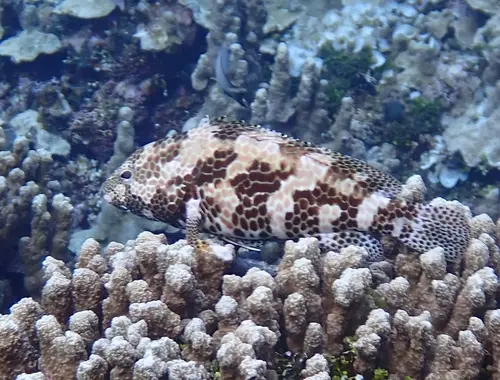
Cá Mú chấm tổ ong

Epinephelus merra Bloch, 1793

WoRMS — Tên hợp lệ trên WoRMS
Tên được xác nhận
Xem trên WoRMS (marinespecies.org)

Thông tin chính

Tên gọi khác
Cá Song chấm tổ ong, Cá Song rạn chấm tổ ong
Common Name (EN)
Honeycomb grouper
Kích thước
9 - 16 cm. Lớn nhất 32 cm.
Size
9 - 16 cm. Maximum 32 cm.

Phân bố

Ấn Độ, Indonesia, Nhật Bản, Philippines, Trung Quốc, Việt Nam. Miền Trung.

Mẫu vật & Tài liệu

Nơi lưu trữ mẫu
Viện Hải dương học (Nha Trang).
Specimen
Institute of Oceanography (Nhatrang).
Tình trạng
Ít gặp.
Status
Uncommon.
Tài liệu dẫn
Weber and de Beaufort, 1931. Herre, 1953. Orsi, 1974.
Literature
Weber and de Beaufort, 1931. Herre, 1953. Orsi, 1974.

Sinh học — Sinh thái BIO

Tên tiếng Anh (FishBase)
Honeycomb grouper
English name (FishBase)
Honeycomb grouper
Chiều dài tối đa
36.5 cm TL
Max length
36.5 cm TL
Trọng lượng tối đa
1,001 g
Max weight
1,001 g
Độ sâu phân bố
0 - 50 m
Depth range
0 - 50 m
Môi trường sống
Neritic, Estuaries, Coral reefs, Benthic, Rocky
Habitat
Neritic, Estuaries, Coral reefs, Benthic, Rocky
Sách Đỏ IUCN
LC
IUCN Red List
LC
Nguy hiểm cho người
reports of ciguatera poisoning
Danger to humans
reports of ciguatera poisoning
Kiểu ăn
Săn mồi lớn (ăn thịt)
Feeding type
hunting macrofauna (predator)
Bậc dinh dưỡng
3.82
Trophic level
3.82
Hình thức sinh sản
protogyny, external fertilization
Reproduction
protogyny, external fertilization
Tập hợp sinh sản
Có — tập hợp sinh sản theo đàn
Spawn aggregation
Yes — forms spawning aggregations
Giá trị thương mại
Thương mại
Importance
commercial
Nuôi trồng thủy sản
Thương mại
Aquaculture
commercial

Ghi chú chi tiết

Tóm tắt sinh học (FishBase)(Biology summary (FishBase))

Loài cá sống đơn độc, phân bố tại các rạn san hô ven bờ và ngoài khơi, thường ở độ sâu dưới 20 m; cũng rất phổ biến tại các đầm phá nông và các rạn san hô phía ngoài biển được che chắn một phần. Cá non thường xuất hiện trong các bụi san hô cành Acropora. Thức ăn chủ yếu gồm các loài giáp xác và cá. Ở loài này, tập tính ăn cá tăng dần theo độ tuổi. Không có gai nắp mang cũng như các rãnh tuyến chứa nọc độc ở vùng trước bên. Thông tin hiện tại trong bảng (cá nguy hiểm) không khớp và cần được kiểm chứng thêm. Loài này đã được nuôi thử nghiệm tại Philippines. Xuất hiện tại các chợ cá sống ở Hồng Kông. Đây là đối tượng quan trọng trong nghề cá thủ công do mật độ phong phú ở vùng nước nông, thường được đánh bắt bằng câu tay, bẫy cá và lao xiên.

Xem văn bản gốc tiếng Anh (FishBase / GBIF)

A solitary fish, in coastal and offshore reefs usually in less than 20 m depth (Ref. 90102); also very common in shallow lagoon and semi-protected seaward reefs. Juveniles are common in thickets of staghorn <i>Acropora</i> corals. Feed on crustaceans and fishes. Increase of piscivory with age is observed in this species. Neither opercular spine nor anterolateral glandular grooves with venom gland is present (Ref. 57406). Current information in the table (dangerous fish) do not match; needs verification. Cultured under experimental conditions in the Philippines (Ref. 4757). In the Hong Kong live fish markets (Ref. 27253). It is important to artisanal fisheries because of its abundance in shallow water and caught with handlines, fish traps, and spear (Ref. 39231).

Ghi chú sinh thái(Ecology notes)

Rất phổ biến tại các đầm phá nông và các rạn san hô phía ngoài biển được che chắn một phần. Cá non thường xuất hiện trong các bụi san hô cành Acropora. Tập tính ăn cá tăng dần theo độ tuổi. Loài này có mối liên hệ với các thảm cỏ biển. Thức ăn bao gồm các loài giáp xác, cá và động vật không xương sống tầng đáy.

Xem văn bản gốc tiếng Anh (FishBase / GBIF)

Very common in shallow lagoon and semi-protected seaward reefs. Juveniles are common in thickets of staghorn <i>Acropora</i> corals. Increase of piscivory with age is observed in this species. (Ref. 11889). Associated with seagrass (Ref. 118046). Feed on crustaceans, fish and benthic invertebrates (Ref. 11889).

Danh pháp đồng nghĩa & Phân loại gốc

Epinephelus merra Bloch, Nat. Ausland, Vol. 7, Fische, p. 17, pl. 329, 1793; Bleeker, 1873 - 76; Boulenger, 1895; Evermann and Seale, 1907; Fowler and Bean, 1922; Weber and de Beaufort; Herre, 1934.
Holocentrus merra Lacépède, Hist. Nat. Poiss., Vol. 4, p. 384, 1802.
Serranus merra Cuvier and Valenciennes, Hist. Nat. Poiss., Vol. 2, p. 325, 1828; Fowler, 1928.
Serranus hexagonatus Cuvier and Valenciennes, Hist. Nat. Poiss., Vol. 2, p. 330, 1828; Richardson, 1844; Gunther, 1873.
Serranus faveatus Cuvier and Valenciennes, Hist. Nat. Poiss., Vol. 2, p. 329, 1828.
Serranus nigriceps Cuvier and Valenciennes, Hist. Nat. Poiss., Vol. 6, p. 517, 1830.
Serranus confertes Bennett, Life Raffles, p. 686, 1930.
Epinephelus hexagonatus Bleeker, Nat. Tijds. Dierk., Vol. 1, p. 232, 1863.
Epinephelus stellans Bleeker, Ned. Tijds. Dierk., Vol. 2, p. 281, 1865.
Epinephelus stellatus Snyder, Proc. U. S. Nat. Mus., Vol. 42, p. 498, 1912.