
Quay lại danh sách
#119Tập 5

Cá Bơn Nhiều Mắt

Grammatobothus polyophthalmus (Bleeker, 1865)

WoRMS — Tên hợp lệ trên WoRMS
Tên được xác nhận
Xem trên WoRMS (marinespecies.org)

Thông tin chính

Tên gọi khác
Cá Thờn bơn Nhiều Mắt, Cá Bơn cát Nhiều Mắt
Common Name (EN)
Threespot flounder
Kích thước
Lớn nhất 210mm.
Size
Maximum 210mm.

Mô tả hình thái

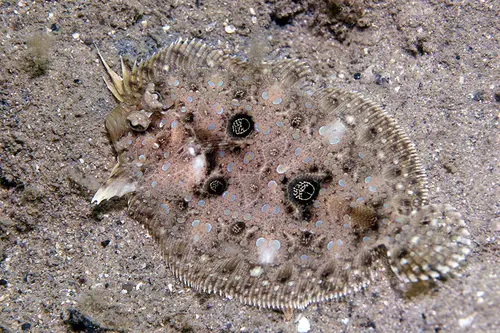
Diagnostic features. D 75 – 84; A 64 – 67; P 15 – 16; C 2 + 13 + 2 = 17; LLs 71 – 80; GR 2 – 5 + 7 – 9 = 12 – 13; vert. 10 + 28 = 38. Body deep ovate, deepest near middle part of body (61.8 – 66.0 % SL). Head much shorter than half of body depth (26.6 – 27.8 % SL); upper profile of head steep with distinct concavity in front of ventral margin of upper eye. Snout shorter than eye diameter. Rostral spine absent. Eye diameter slightly shorter than upper-jaw length. Interorbital space with a narrow concave space, its width about 1 / 3 of eye diameter. Mouth small, upper-jaw length 8.5 – 8.8 % SL; maxilla extending to or slightly beyond anterior margin of lower eye; several short and blunt prominent spines along upper jaw. Teeth on both jaws uniserial, upper-jaw teeth becoming gradually smaller backward; all teeth of lower jaw about same size, similar to anterior teeth of upper jaw. Gill rakers very small on upper limb and slender on lower limb, all not serrated. Scales on ocular side very small, ctenoid with one row of short ctenii on posterior margin, cycloid on blind side. Second to tenth rays of dorsal fin prolonged, lengths in males longer than those in females; 4 th or 5 th rays longest, its length in males slightly longer than head; fin membranes behind prolonged rays deeply incised, and membrane on posterior surface of prolonged rays expanded, forming pinniform rays. Pectoral-fin rays on ocular side very long in males, length of pectoral fin 19.7 – 37.4 % SL, not elongate in females. Coloration. Ocular side of body pale brownish, with three large prominent dark ocelli, two anteriormost above and below pectoral fin, one posteriormost midway along straight portion of lateral line, and with many more or less regularly distributed small, distinct, dark spots (light blue in fresh); one or two distinct chromosome-shaped dark bars (deep blue in fresh) above upper eye in males; dorsal and anal fins with indistinct dark blotches; pectoral fin on ocular side with broad palEN · FishBase/GBIF

Sinh thái & Dinh dưỡng

Habitat: Soft bottom. Feeding: hunting macrofauna (predator). Depth range: 0 - 90 m. Found in shallow mud, sand, and rubble bottoms of the continental shelf. Feeds on benthic animals.EN · FishBase/GBIF

Phân bố

Ấn Độ, Xri Lanca, Ốttrâylia, Inđônêxia, Philíppin, Thái Lan, Nhật Bản. Miền Trung Việt Nam.

Giá trị kinh tế

Commercial importance: commercial. Price category: very high. Aquaculture: never/rarely. Vulnerability index: 11.0/100EN · FishBase/GBIF

Mẫu vật & Tài liệu

Nơi lưu trữ mẫu
Viện Hải Dương Học (Nha Trang).
Specimen
Institute of Oceanography (Nha Trang).
Tình trạng
Ít gặp.
Status
Uncommon.
Tài liệu dẫn
Weber and De Beaufort, 1929. Herre, 1953.
Literature
Weber and De Beaufort, 1929. Herre, 1953.

Sinh học — Sinh thái BIO

Tên tiếng Anh (FishBase)
Threespot flounder
English name (FishBase)
Threespot flounder
Chiều dài tối đa
21.0 cm TL
Max length
21.0 cm TL
Độ sâu phân bố
0 - 90 m
Depth range
0 - 90 m
Môi trường sống
Soft bottom
Habitat
Soft bottom
Nguy hiểm cho người
Vô hại
Danger to humans
harmless
Kiểu ăn
Săn mồi lớn (ăn thịt)
Feeding type
hunting macrofauna (predator)
Bậc dinh dưỡng
3.63
Trophic level
3.63
Hình thức sinh sản
Phân giới tính, thụ tinh ngoài
Reproduction
dioecism, external fertilization
Giá trị thương mại
Thương mại
Importance
commercial
Nuôi trồng thủy sản
Không/hiếm khi
Aquaculture
never/rarely

Ghi chú chi tiết

Tóm tắt sinh học (FishBase)(Biology summary (FishBase))

Phân bố tại các vùng đáy nông bùn, cát và sỏi đá ở thềm lục địa (Ref. 9824). Thức ăn chủ yếu gồm các loài động vật đáy. Được tiêu thụ dưới dạng tươi sống và sử dụng để chế biến bột cá (Ref. 9824).

Xem văn bản gốc tiếng Anh (FishBase / GBIF)

Found in shallow mud, sand, and rubble bottoms of the continental shelf (Ref. 9824). Feeds on benthic animals. Marketed fresh and used in making fish meal (Ref. 9824).

Ghi chú sinh thái(Ecology notes)

Sinh sống ở các vùng đáy nông bùn, cát và sỏi đá của thềm lục địa. Chuyên ăn các loài động vật đáy.

Xem văn bản gốc tiếng Anh (FishBase / GBIF)

Found in shallow mud, sand, and rubble bottoms of the continental shelf. Feeds on benthic animals.

Mô tả hình thái (GBIF)(Morphological description (GBIF))

Đặc điểm chẩn loại. Vây lưng D 75 – 84; Vây hậu môn A 64 – 67; Vây ngực P 15 – 16; Vây đuôi C 2 + 13 + 2 = 17; Vảy đường bên LLs 71 – 80; Lược mang GR 2 – 5 + 7 – 9 = 12 – 13; Đốt sống vert. 10 + 28 = 38. Thân hình bầu dục rộng, điểm sâu nhất nằm gần phần giữa cơ thể (61,8 – 66,0 % SL). Đầu ngắn hơn nhiều so với một nửa chiều sâu cơ thể (26,6 – 27,8 % SL); đường viền phía trên của đầu dốc với vết lõm rõ rệt ở phía trước mép bụng của mắt trên. Mõm ngắn hơn đường kính mắt. Không có gai mõm. Đường kính mắt ngắn hơn một chút so với chiều dài hàm trên. Khoảng gian ổ mắt có một khoảng lõm hẹp, chiều rộng bằng khoảng 1/3 đường kính mắt. Miệng nhỏ, chiều dài hàm trên 8,5 – 8,8 % SL; xương hàm trên kéo dài đến hoặc vượt qua nhẹ mép trước của mắt dưới; có một số gai nổi bật ngắn và tù dọc theo hàm trên. Răng ở cả hai hàm xếp thành một hàng đơn, răng hàm trên nhỏ dần về phía sau; tất cả các răng ở hàm giống nhau về kích thước, tương tự như các răng phía trước của hàm trên. Lược mang rất nhỏ ở nhánh trên và mảnh ở nhánh tất cả đều không có răng cưa. Vảy ở mặt có mắt rất nhỏ, vảy lược với một hàng răng lược ngắn ở mép sau, vảy tròn ở mặt không có mắt. Các tia vây từ thứ hai đến thứ mười của vây lưng kéo dài, chiều dài ở con đực lớn hơn ở con cái; tia thứ 4 hoặc thứ 5 dài nhất, chiều dài ở con đực dài hơn đầu một chút; màng vây phía sau các tia kéo dài bị xẻ sâu, và màng trên bề mặt phía sau của các tia kéo dài mở rộng, tạo thành các tia hình lông chim. Các tia vây ngực ở mặt có mắt rất dài ở con đực, chiều dài vây ngực 19,7 – 37,4 % SL, không kéo dài ở con cái. Màu sắc. Mặt có mắt của cơ thể có màu nâu nhạt, với ba đốm mắt lớn màu sẫm nổi bật, hai đốm phía trước nằm ở phía trên và dưới vây ngực, một đốm phía sau nằm ở giữa phần thẳng của đường bên, kèm theo nhiều đốm nhỏ màu sẫm phân bố tương đối đều (màu xanh lam nhạt khi còn tươi); có một hoặc hai vạch sẫm hình nhiễm sắc thể rõ rệt (màu xanh lam đậm khi còn tươi) ở phía trên mắt trên ở con đực; vây lưng và vây hậu môn có các đốm mờ nhạt; vây ngực ở mặt có mắt mang một dải rộng

Xem văn bản gốc tiếng Anh (FishBase / GBIF)

Diagnostic features. D 75 – 84; A 64 – 67; P 15 – 16; C 2 + 13 + 2 = 17; LLs 71 – 80; GR 2 – 5 + 7 – 9 = 12 – 13; vert. 10 + 28 = 38. Body deep ovate, deepest near middle part of body (61.8 – 66.0 % SL). Head much shorter than half of body depth (26.6 – 27.8 % SL); upper profile of head steep with distinct concavity in front of ventral margin of upper eye. Snout shorter than eye diameter. Rostral spine absent. Eye diameter slightly shorter than upper-jaw length. Interorbital space with a narrow concave space, its width about 1 / 3 of eye diameter. Mouth small, upper-jaw length 8.5 – 8.8 % SL; maxilla extending to or slightly beyond anterior margin of lower eye; several short and blunt prominent spines along upper jaw. Teeth on both jaws uniserial, upper-jaw teeth becoming gradually smaller backward; all teeth of lower jaw about same size, similar to anterior teeth of upper jaw. Gill rakers very small on upper limb and slender on lower limb, all not serrated. Scales on ocular side very small, ctenoid with one row of short ctenii on posterior margin, cycloid on blind side. Second to tenth rays of dorsal fin prolonged, lengths in males longer than those in females; 4 th or 5 th rays longest, its length in males slightly longer than head; fin membranes behind prolonged rays deeply incised, and membrane on posterior surface of prolonged rays expanded, forming pinniform rays. Pectoral-fin rays on ocular side very long in males, length of pectoral fin 19.7 – 37.4 % SL, not elongate in females. Coloration. Ocular side of body pale brownish, with three large prominent dark ocelli, two anteriormost above and below pectoral fin, one posteriormost midway along straight portion of lateral line, and with many more or less regularly distributed small, distinct, dark spots (light blue in fresh); one or two distinct chromosome-shaped dark bars (deep blue in fresh) above upper eye in males; dorsal and anal fins with indistinct dark blotches; pectoral fin on ocular side with broad pal

Danh pháp đồng nghĩa & Phân loại gốc

Platophrys polyophthalmus Bleeker, Ned. Tijds. Dierk., Vol.3, p.46, 1866. McCulloch, 1922.
Rhomboidichthys angustifrons Gunther, Report Voy. Challenger, Zool., Vol.1, Shore Fishes, p.46, pl.21, fig.B, 1880.
Platophrys angustifrons Jenkins, Mem. Ind. Mus., Vol.3, p.27, 1910.
Grammatobothus polyophthalmus Norman, Biol. Results Endeavour, Vol.5, p.253, 1926. Norman, 1927. McCulloch, 1929. Norman, 1934.
Bothus (Platophrys) polyophthalmus Weber and De Beaufort, Fishes Indo - Austr. Arch., Vol.5, p.119, 1929.