
Quay lại danh sách
#157Tập 5

Cá Bơn Lưỡi Trâu Dài
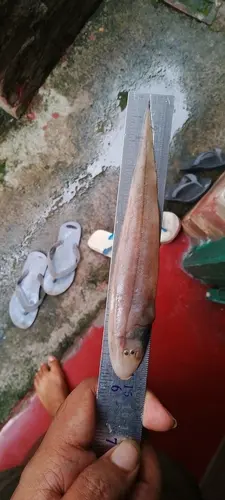
Cynoglossus lingua Hamilton, 1822

WoRMS — Tên hợp lệ trên WoRMS
Tên được xác nhận
Xem trên WoRMS (marinespecies.org)

Thông tin chính

Tên gọi khác
Cá Lưỡi trâu dài, Cá luoi trâu
Common Name (EN)
Long tonguesole
Kích thước
Lớn nhất 400mm.
Size
Maximum 400mm.

Mô tả hình thái

Specimen 1 (deformed): The specimen measured 30.5 cm in length and exhibited pronounced caudal deformity with fin regeneration. The deformity appeared to result from a prior transverse injury that led to the partial loss of the original caudal fin structure (Figure 2 e). However, the newly formed caudal region lacked the typical symmetrical tapering characteristics of intact specimens. The abrupt termination of the body resulted in a decrease in the total number of mid-lateral line scales (84) and the regenerated caudal fin displayed an increase in the number of fin rays (16) compared to the normal specimens (10). Further examination using X-ray radiography revealed significant skeletal alterations, including a vertebral column termination resulting in a reduced vertebral count (49) relative to con-specific (Figure 3 d). Specimen 2 (deformed): This specimen measured 33 cm in total length and exhibited a notable morphological anomaly in the caudal region (Figure 2 f), similar to that observed in Specimen 1. However, unlike the previous specimen, the regenerated caudal fin in this individual was structurally more complex, featuring two accessory fins joined on each lateral side of the main caudal fin. The regenerated specimens showed a reduced number of mid-lateral line scales and a marked increase in the total number of caudal fin rays (including accessory rays), compared to normal specimens. X-ray radiography of this specimen also revealed fusion of vertebrae in the caudal region and this affected the normal segmentation of the vertebral column, leading to a reduction in the total vertebral count to 51 (Figure 3 e).EN · FishBase/GBIF

Sinh thái & Dinh dưỡng

Habitat: Estuaries. Depth range: 10 - 961 mEN · FishBase/GBIF

Phân bố

Biển Đỏ, Pakíxtan, Ấn Độ, Inđônêxia, Malaixia, Philíppin, Thái Lan. Miền Trung, Nam Bộ Việt Nam.

Giá trị kinh tế

Commercial importance: commercial. Price category: very high. Aquaculture: never/rarely. Vulnerability index: 35.0/100EN · FishBase/GBIF

Mẫu vật & Tài liệu

Nơi lưu trữ mẫu
Viện Hải Dương Học (Nha Trang).
Specimen
Institute of Oceanography (Nha Trang).
Tình trạng
Ít gặp.
Status
Uncommon.
Tài liệu dẫn
Weber and De Beaufort, 1929. Mai Đình Yên, 1992.
Literature
Weber and De Beaufort, 1929. Mai, 1992.

Sinh học — Sinh thái BIO

Tên tiếng Anh (FishBase)
Long tongue sole
English name (FishBase)
Long tongue sole
Chiều dài tối đa
45.0 cm TL
Max length
45.0 cm TL
Độ sâu phân bố
10 - 961 m
Depth range
10 - 961 m
Môi trường sống
Estuaries
Habitat
Estuaries
Nguy hiểm cho người
Vô hại
Danger to humans
harmless
Hình thức sinh sản
Phân giới tính, thụ tinh ngoài
Reproduction
dioecism, external fertilization
Giá trị thương mại
Thương mại
Importance
commercial
Nuôi trồng thủy sản
Không/hiếm khi
Aquaculture
never/rarely

Ghi chú chi tiết

Tóm tắt sinh học (FishBase)(Biology summary (FishBase))

Cá trưởng thành sinh sống chủ yếu ở vùng đáy bùn và cát nông của thềm lục địa, đôi khi di chuyển vào các cửa sông và sông chịu ảnh hưởng của thủy triều (Ref. 1479, 48637). Thường vùi mình sâu dưới chất đáy vàoban ngày, và bơi ra săn mồi vào ban đêm (Ref. 48637). Thức ăn chủ yếu gồm các loài động vật không xương sống ở tầng đáy. Thường được thương mại hóa dưới dạng tươi sống và đông lạnh; ngoài ra còn được phơi khô hoặc muối mặn (Ref. 9895).

Xem văn bản gốc tiếng Anh (FishBase / GBIF)

Adults live mainly in shallow muddy and sandy bottoms of the continental shelf, sometimes entering estuaries and tidal rivers (Ref. 1479, 48637). Usually deeply buried in the substrate during the day, but out and hunting at night (Ref. 48637). They feed mainly on benthic invertebrates. Marketed mostly fresh and frozen; also dried-salted (Ref. 9895).

Mô tả hình thái (GBIF)(Morphological description (GBIF))

Mẫu vật 1 (bị biến dạng): Mẫu vật có chiều dài 30,5 cm và thể hiện sự biến dạng rõ rệt ở vùng đuôi kèm theo sự tái sinh của vây. Sự biến dạng này dường như là kết quả của một tổn thương ngang trước đó dẫn đến sự mất một phần cấu trúc vây đuôi nguyên bản (Hình 2e). Tuy nhiên, vùng đuôi mới hình thành lại thiếu đi các đặc điểm thon gọn đối xứng điển hình như ở các mẫu vật nguyên vẹn. Việc cơ thể bị cụt đột ngột đã làm giảm tổng số lượng vảy trên đường giữa thân (84 vảy) và vây đuôi được tái sinh cho thấy số lượng tia vây tăng lên (16 tia) so với các mẫu vật bình thường (10 tia). Kiểm tra thêm bằng chụp X-quang cho thấy những biến đổi đáng kể về bộ xương, bao gồm việc cột sống bị kết thúc sớm dẫn đến số lượng đốt sống giảm (49 đốt) so với cá thể cùng loài (Hình 3d). Mẫu vật 2 (bị biến dạng): Mẫu vật này có tổng chiều dài 33 cm và thể hiện một dị thường hình thái đáng chú ý ở vùng đuôi (Hình 2f), tương tự như quan sát ở Mẫu vật 1. Tuy nhiên, không giống như mẫu vật trước, vây đuôi được tái sinh ở cá thể này có cấu trúc phức tạp hơn, nổi bật với hai vây phụ gắn ở mỗi bên sườn của vây đuôi chính. Các mẫu vật tái sinh cho thấy số lượng vảy trên đường giữa thân giảm và tổng số tia vây đuôi (bao gồm cả các tia vây phụ) tăng rõ rệt so với các mẫu vật bình thường. Chụp X-quang mẫu vật này cũng cho thấy sự hợp nhất của các đốt sống ở vùng đuôi, điều này ảnh hưởng đến sự phân đoạn bình thường của cột sống, dẫn đến việc tổng số đốt sống giảm xuống còn 51 đốt (Hình 3e).

Xem văn bản gốc tiếng Anh (FishBase / GBIF)

Specimen 1 (deformed): The specimen measured 30.5 cm in length and exhibited pronounced caudal deformity with fin regeneration. The deformity appeared to result from a prior transverse injury that led to the partial loss of the original caudal fin structure (Figure 2 e). However, the newly formed caudal region lacked the typical symmetrical tapering characteristics of intact specimens. The abrupt termination of the body resulted in a decrease in the total number of mid-lateral line scales (84) and the regenerated caudal fin displayed an increase in the number of fin rays (16) compared to the normal specimens (10). Further examination using X-ray radiography revealed significant skeletal alterations, including a vertebral column termination resulting in a reduced vertebral count (49) relative to con-specific (Figure 3 d). Specimen 2 (deformed): This specimen measured 33 cm in total length and exhibited a notable morphological anomaly in the caudal region (Figure 2 f), similar to that observed in Specimen 1. However, unlike the previous specimen, the regenerated caudal fin in this individual was structurally more complex, featuring two accessory fins joined on each lateral side of the main caudal fin. The regenerated specimens showed a reduced number of mid-lateral line scales and a marked increase in the total number of caudal fin rays (including accessory rays), compared to normal specimens. X-ray radiography of this specimen also revealed fusion of vertebrae in the caudal region and this affected the normal segmentation of the vertebral column, leading to a reduction in the total vertebral count to 51 (Figure 3 e).

Danh pháp đồng nghĩa & Phân loại gốc

Cynoglossus lingua Hamilton - Buchanan, Fishes Ganges, pls.32, p.365, 1822. Weber and De Beaufort, 1929.
Pleuronectes potous Cuvier, Regne Animal, Vol.4, p.307, footnote (name only), 1836.
Plagusia lingua Cantor, Catalogue Malay Fish. Jour. Asiat. Soc. Bengal, Vol.18, p.1215, 1850.
Plagusia potous Bleeker, Verh. Bat. Gen., Vol.24, Pleuronect, p.23, 1852.
Arelia lingua Kaup, Arch. f. Naturgesch., Vol.24, No.1, p.107, 1858.
Arelia potous Bleeker, Acta Soc. Sci. Indo - Neerl., Vol.6, Enum. Spec. pisc. p.185, 1859.
Cynoglossus lingua Gunther, Cat. British Mus., Vol.4, p.501, 1862. Day, 1878 - 1888. Vinciguerra, 1890.
Cynoglossus macrorhynchus Kner, Novara Exp. Fische, Vol.3, Abth, p.295, 1867 (no Bleeker).
Cynoglossus potous Bleeker, Atlas Ichth., Vol.6, p.33, 1866 - 1872.
Cynoglossus acinaces Jenkins, Bull. U.S. Fish. Comm., Vol.30, 1910.