Quay lại danh sách
#17Tập 5

Loài cá Mù Làn Chấm Hoa

Dendrochirus zebra (Cuvier and Valenciennes, 1829)

WoRMS — Tên hợp lệ trên WoRMS
Tên được xác nhận · cập nhật WoRMS: 2026-09-02
Xem trên WoRMS (marinespecies.org)

Thông tin chính

Tên gọi khác
Cá Mao Tiên, Cá Mao tiên cánh quạt, Cá Mù làn chấm hoa
Common Name (EN)
Zebra turkeyfish
Kích thước
Lớn nhất 250mm.
Size
Maximum 250mm.

Mô tả hình thái

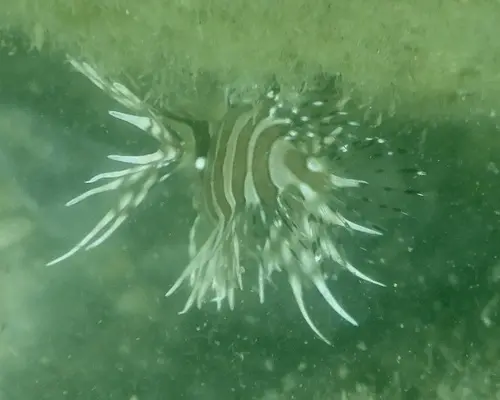
Diagnosis: The body is moderately elongated and laterally compressed, with a broad head. The snout is blunt, and the eyes are large, with cirri present anteriorly. The body is dark brown with 12 white stripes. The post-pectoral stripes (4 th and 5 th) originate from the ventral side, bifurcate at the lateral line, and merge with the dorsal spine. The 6 th to 9 th stripes is separated. The dorsal spine has alternating dark and white bands. The dorsal, anal, and caudal fin (median fins) rays have dark spots, while the extended pectoral fin rays are white. The species is commonly found on rocky reef flats, in sheltered areas such as caves and creeks, and rarely forms small aggregations.EN · FishBase/GBIF

Sinh thái & Dinh dưỡng

Habitat: Neritic, Coral reefs, Benthic, Soft bottom, Mud. Feeding: hunting macrofauna (predator). Depth range: 0 - 115 m. Found in inshore waters (Ref. 75154); on coral, rubble, or rock bottoms of reef flats (Ref. 9710); also in coastal to outer reef habitats in sheltered lagoons and in caves, sometimes in small aggregations. Usually shallow, from 3-60m (Ref. 30874) but also reported to 80 m depth.EN · FishBase/GBIF

Phân bố

Đông Châu Phi, Đông Ấn Độ Dương, Biển Đỏ, Ôttrâylia, Inđônêxia, Philíppin, Haoai, Trung Quốc, Thái Lan, Quần Đảo Samoa. Vịnh Bắc Bộ, Miền Trung Việt Nam

Giá trị kinh tế

Commercial importance: minor commercial. Price category: high. Aquaculture: never/rarely. Vulnerability index: 20.5/100EN · FishBase/GBIF

Mẫu vật & Tài liệu

Nơi lưu trữ mẫu
Viện Hải Dương Học (Nha Trang).
Specimen
Institute of Oceanography (Nha Trang).
Tình trạng
Thường gặp.
Status
Common.
Tài liệu dẫn
Herre, 1953. Chu Nguyên Đinh, 1962. Orsi, 1974. Shen, 1993.
Literature
Herre, 1953. Chu, 1962. Orsi, 1974. Shen, 1993.

Sinh học — Sinh thái BIO

Tên tiếng Anh (FishBase)
Zebra turkeyfish
English name (FishBase)
Zebra turkeyfish
Chiều dài tối đa
25.0 cm SL
Max length
25.0 cm SL
Độ sâu phân bố
0 - 115 m
Depth range
0 - 115 m
Môi trường sống
Neritic, Coral reefs, Benthic, Soft bottom, Mud
Habitat
Neritic, Coral reefs, Benthic, Soft bottom, Mud
Nguy hiểm cho người
Có nọc độc
Danger to humans
venomous
Kiểu ăn
Săn mồi lớn (ăn thịt)
Feeding type
hunting macrofauna (predator)
Hình thức sinh sản
Phân giới tính, thụ tinh ngoài
Reproduction
dioecism, external fertilization
Giá trị thương mại
Thương mại nhỏ
Importance
minor commercial
Nuôi trồng thủy sản
Không/hiếm khi
Aquaculture
never/rarely

Ghi chú chi tiết

Tóm tắt sinh học (FishBase)(Biology summary (FishBase))

Phân bố trên nền đáy san hô, đá vụn hoặc đá của các mặt phẳng rạn san hô; cũng được tìm thấy ở các sinh cảnh từ ven bờ đến rạn san hô ngoài khơi trong các đầm phá kín và trong các hang động, đôi khi tập trung thành các nhóm nhỏ. Thường sống ở vùng nước nông, từ 3-60m nhưng cũng ghi nhận ở độ sâu đến 80m. Các giai đoạn ấu trùng trôi nổi di chuyển quãng đường dài và phát tán đến các vùng cận nhiệt đới. Đã được ghi nhận sinh sản trong điều kiện nuôi giữ. Các tia vây có tuyến độc.

Xem văn bản gốc tiếng Anh (FishBase / GBIF)

Found on coral, rubble, or rock bottoms of reef flats (Ref. 9710); also in coastal to outer reef habitats in sheltered lagoons and in caves, sometimes in small aggregations. Usually shallow, from 3-60m (Ref. 30874) but also reported to 80 m depth. Pelagic stages travel great distances and expatriate to sub-tropical zones (Ref. 48635). Spawned in captivity (Ref. 37816). Spines with poison glands (Ref. 125576).

Ghi chú sinh thái(Ecology notes)

Phân bố ở vùng nước ven bờ; trên nền đáy san hô, đá vụn hoặc đá của các mặt phẳng rạn san hô; cũng được tìm thấy ở các sinh cảnh từ ven bờ đến rạn san hô ngoài khơi trong các đầm phá kín và trong các hang động, đôi khi tập trung thành các nhóm nhỏ. Thường sống ở vùng nước nông, từ 3-60m nhưng cũng ghi nhận ở độ sâu đến 80m.

Xem văn bản gốc tiếng Anh (FishBase / GBIF)

Found in inshore waters (Ref. 75154); on coral, rubble, or rock bottoms of reef flats (Ref. 9710); also in coastal to outer reef habitats in sheltered lagoons and in caves, sometimes in small aggregations. Usually shallow, from 3-60m (Ref. 30874) but also reported to 80 m depth.

Ghi chú sinh sản(Reproduction notes)

Sinh sản theo cặp. Hành vi ve vãn và sinh sản diễn ra vào ban đêm. Con đực có tính hung dữ, con cái có kích thước nhỏ hơn và phần mặt chuyển sang màu gần như trắng khi trong giai đoạn ve vãn. Việc phóng thích trứng diễn ra tại đỉnh của một cú bơi vút lên theo cặp ngắn và nhanh, tạo ra một khối trứng dạng gelatin gồm từ 2.000 đến 15.000 trứng. Trứng nở sau 36 giờ và ấu trùng chuyển sang đời sống đáy sau vài tuần ở kích thước 10-12 mm.

Xem văn bản gốc tiếng Anh (FishBase / GBIF)

Spawn in pairs. Courtship and spawning occur at night. Males aggressive, females are smaller and develop almost white face when in courtship. Spawning occurs at the apex of a short and rapid paired ascent resulting in a gelatinous mass of 2,000 to 15,000 eggs. Hatching occurs 36 hours later and larvae settle out in a few weeks at a size of 10-12 mm.

Mô tả hình thái (GBIF)(Morphological description (GBIF))

Đặc điểm chẩn loại: Cơ thể thuôn dài vừa phải và dẹp bên, với phần đầu rộng. Mõm tù, mắt lớn, có các thùy râu (cirri) ở phía trước. Cơ thể màu nâu sẫm với 12 sọc trắng. Các sọc phía sau vây ngực (sọc thứ 4 và thứ 5) xuất phát từ phía bụng, phân nhánh tại đường bên và hòa nhập với gai vây lưng. Các sọc từ thứ 6 đến thứ 9 tách rời nhau. Gai vây lưng có các dải màu tối và trắng xen kẽ. Các tia vây của vây lưng, vây hậu môn và vây đuôi (các vây giữa) có các đốm tối, trong khi các tia vây ngực kéo dài có màu trắng. Loài này thường được tìm thấy trên các mặt phẳng rạn đá, ở các khu vực kín gió như hang động và lạch nước, và hiếm khi tập hợp thành các đàn nhỏ.

Xem văn bản gốc tiếng Anh (FishBase / GBIF)

Diagnosis: The body is moderately elongated and laterally compressed, with a broad head. The snout is blunt, and the eyes are large, with cirri present anteriorly. The body is dark brown with 12 white stripes. The post-pectoral stripes (4 th and 5 th) originate from the ventral side, bifurcate at the lateral line, and merge with the dorsal spine. The 6 th to 9 th stripes is separated. The dorsal spine has alternating dark and white bands. The dorsal, anal, and caudal fin (median fins) rays have dark spots, while the extended pectoral fin rays are white. The species is commonly found on rocky reef flats, in sheltered areas such as caves and creeks, and rarely forms small aggregations.

Danh pháp đồng nghĩa & Phân loại gốc

Pterois zebra Cuvier and Valenciennes, Hist. Nat. Poiss., Vol.4, p.270, 1829. Quoy and Gaimard, 1834. Bleeker, 1849. Gunther, 1870 - 1875. Garman, 1903. Barnard, 1927.
Pseudomonopterus zebra Bleeker, Ned. Tijds. Dierk., Vol.1, p.234, 1863.
Pseudomonopterus (Dendrochirus) zebra Bleeker, Verh. Akad. Amsterdam, Vol.16, p.50, 1876. Bleeker, 1878.
Dendrochyrus zebra Jordan and Seale, Bull. U.S. Bur. Fisheries, Vol.25, p.378, 1906. Evermann and Seale, 1907. Fowler, 1928. Herre, 1953.
Brachirus zebra Matsubara, Fish Morphology and Hierarchy, p.1087, 1955.