
Quay lại danh sách
#175Tập 5

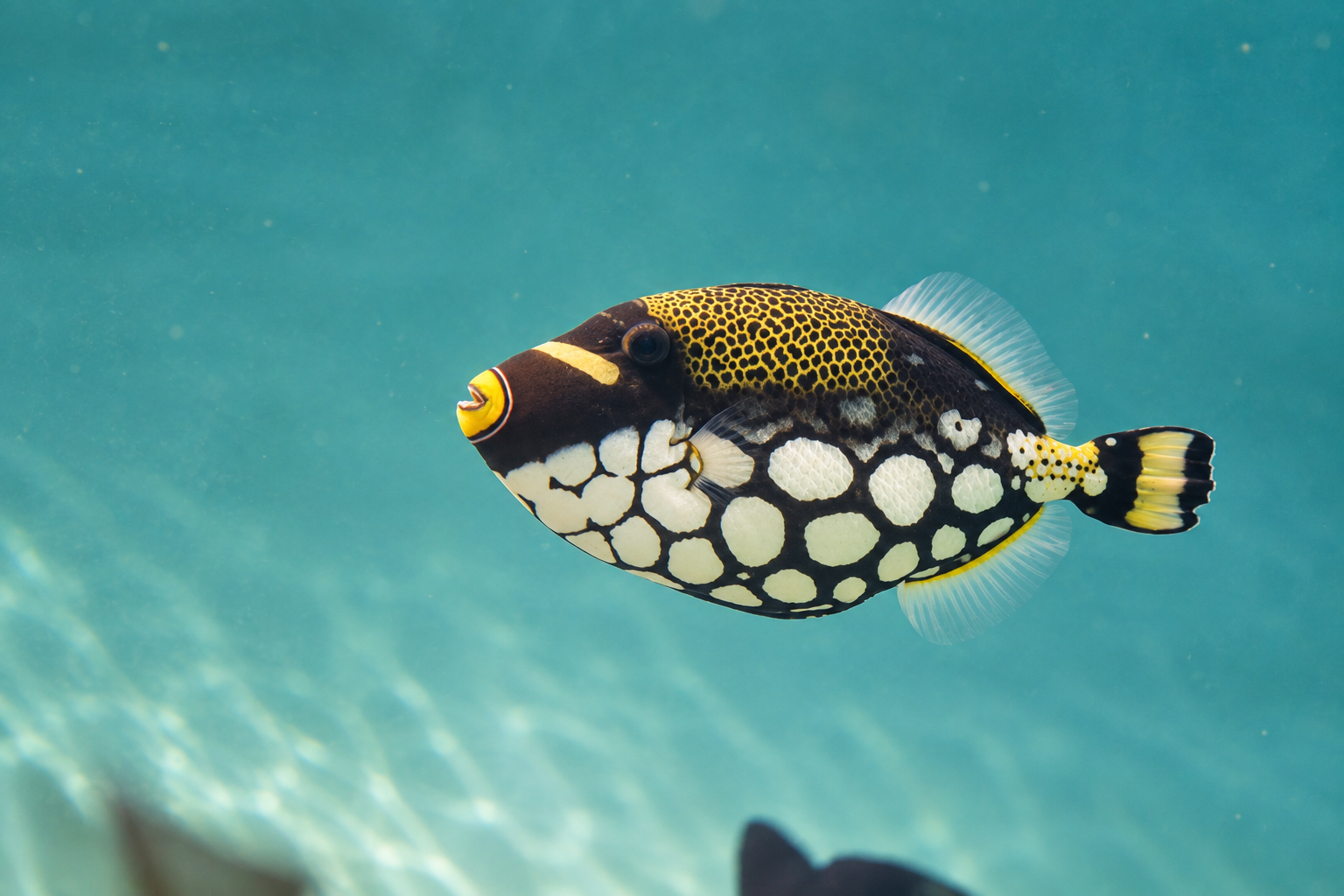
Cá Bò Hoa Vàng

Balistoides conspicillum (Bloch & Schneider, 1801)

WoRMS — Tên hợp lệ trên WoRMS
Tên được xác nhận
Xem trên WoRMS (marinespecies.org)

Thông tin chính

Tên gọi khác
Cá Bò gai vây
Common Name (EN)
clown triggerfish
Kích thước
Lớn nhất 50cm.
Size
Maximum 50cm.

Mô tả hình thái

Lives in clear coastal to outer reef habitats (Ref. 48637). Occurs in clear seaward reefs adjacent to steep drop-offs. A solitary species (Ref. 9710). Uncommon to rare throughout most of its range (Ref. 9770). Adults usually seen along deep drop-offs, swimming about openly and may retreat to caves when approached. Juveniles secretive in small caves with rich invertebrate growth (Ref. 48637). Diet consists of sea urchins, crabs and other crustaceans, mollusks, and tunicates (Ref. 9770). Marketed fresh (Ref. 9770). Among the most highly prized aquarium fishes (Ref. 1602).EN · FishBase/GBIF

Sinh thái & Dinh dưỡng

Habitat: Coral reefs, Soft bottom, Mud, Rocky. Feeding: hunting macrofauna (predator). Depth range: 1 - 75 m. The habitat consists of clear waters of outer reef slopes at depth between about 5 and 75 m. Juveniles are very secretive, mainly confining themselves to caves below 20 m depth on steep drop offs (Ref. 54301). Lives in clear coastal to outer reef habitats (Ref. 48637). A solitary species (Ref. 9710). Uncommon to rare throughout most of its range (Ref. 9770). Adults usually seen along deep drop-offs, swimming about openly and may retreat to caves when approached. Juveniles secretive in small caves with rich invertebrate growth (Ref. 48637). Diet consists of sea urchins, crabs and other crustaceans, mollusks, and tunicates (Ref. 9770).EN · FishBase/GBIF

Phân bố

Đông Châu Phi, Mauritiux, Ấn Độ, Ốttrâylia, Inđônêxia, Philíppin, Thái Lan, Trung Quốc, Đài Loan, Nhật Bản. Miền Trung, Quần đảo Trường Sa.

Giá trị kinh tế

Commercial importance: minor commercial. Price category: medium. Aquaculture: never/rarely. Vulnerability index: 40.0/100EN · FishBase/GBIF

Mẫu vật & Tài liệu

Nơi lưu trữ mẫu
Viện Hải Dương Học (Nha Trang).
Specimen
Institute of Oceanography (Nha Trang).
Tình trạng
Ít gặp.
Status
Uncommon.
Tài liệu dẫn
Herre, 1953. De Beaufort and Briggs, 1962. Shen, 1993.
Literature
Herre, 1953. De Beaufort and Briggs, 1962. Shen, 1993.

Sinh học — Sinh thái BIO

Tên tiếng Anh (FishBase)
Clown triggerfish
English name (FishBase)
Clown triggerfish
Chiều dài tối đa
50.0 cm TL
Max length
50.0 cm TL
Độ sâu phân bố
1 - 75 m
Depth range
1 - 75 m
Môi trường sống
Coral reefs, Soft bottom, Mud, Rocky
Habitat
Coral reefs, Soft bottom, Mud, Rocky
Nguy hiểm cho người
reports of ciguatera poisoning
Danger to humans
reports of ciguatera poisoning
Kiểu ăn
Săn mồi lớn (ăn thịt)
Feeding type
hunting macrofauna (predator)
Hình thức sinh sản
Phân giới tính, thụ tinh ngoài
Reproduction
dioecism, external fertilization
Giá trị thương mại
Thương mại nhỏ
Importance
minor commercial
Nuôi trồng thủy sản
Không/hiếm khi
Aquaculture
never/rarely

Ghi chú chi tiết

Tóm tắt sinh học (FishBase)(Biology summary (FishBase))

Sinh sống tại các vùng nước trong từ vùng ven biển đến các sinh cảnh rạn san hô ngoài khơi. Xuất hiện ở các rạn san hô hướng biển trong vắt nằm kề các bờ dốc đứng dưới biển. Là loài sống đơn độc. Ít phổ biến đến quý hiếm ở phần lớn vùng phân bố. Cá trưởng thành thường được quan sát thấy dọc theo các bờ dốc đứng ở vùng nước sâu, bơi lội tự do ngoài khơi và có thể rút vào hang khi có người đến gần. Cá con có tập tính ẩn náu trong các hang nhỏ có hệ động vật không xương sống phát triển phong phú. Thức ăn chủ yếu gồm cầu gai, cua và các loài giáp xác khác, động vật thân mềm và hải tiêu. Được thương mại dạng tươi sống. Là một trong những loài cá cảnh được săn lùng nhiều nhất.

Xem văn bản gốc tiếng Anh (FishBase / GBIF)

Lives in clear coastal to outer reef habitats (Ref. 48637). Occurs in clear seaward reefs adjacent to steep drop-offs. A solitary species (Ref. 9710). Uncommon to rare throughout most of its range (Ref. 9770). Adults usually seen along deep drop-offs, swimming about openly and may retreat to caves when approached. Juveniles secretive in small caves with rich invertebrate growth (Ref. 48637). Diet consists of sea urchins, crabs and other crustaceans, mollusks, and tunicates (Ref. 9770). Marketed fresh (Ref. 9770). Among the most highly prized aquarium fishes (Ref. 1602).

Ghi chú sinh thái(Ecology notes)

Môi trường sống bao gồm vùng nước trong của sườn ngoài rạn san hô ở độ sâu khoảng từ 5 đến 75 m. Cá con có tập tính ẩn náu rất kỹ, chủ yếu ẩn mình trong các hang ở độ sâu dưới 20 m trên các bờ dốc đứng. Sinh sống tại các vùng nước trong từ vùng ven biển đến các sinh cảnh rạn san hô ngoài khơi. Là loài sống đơn độc. Ít phổ biến đến quý hiếm ở phần lớn vùng phân bố. Cá trưởng thành thường được quan sát thấy dọc theo các bờ dốc đứng ở vùng nước sâu, bơi lội tự do ngoài khơi và có thể rút vào hang khi có người đến gần. Cá con ẩn nấp trong các hang nhỏ có hệ động vật không xương sống phát triển phong phú. Thức ăn chủ yếu gồm cầu gai, cua và các loài giáp xác khác, động vật thân mềm và hải tiêu.

Xem văn bản gốc tiếng Anh (FishBase / GBIF)

The habitat consists of clear waters of outer reef slopes at depth between about 5 and 75 m. Juveniles are very secretive, mainly confining themselves to caves below 20 m depth on steep drop offs (Ref. 54301). Lives in clear coastal to outer reef habitats (Ref. 48637). A solitary species (Ref. 9710). Uncommon to rare throughout most of its range (Ref. 9770). Adults usually seen along deep drop-offs, swimming about openly and may retreat to caves when approached. Juveniles secretive in small caves with rich invertebrate growth (Ref. 48637). Diet consists of sea urchins, crabs and other crustaceans, mollusks, and tunicates (Ref. 9770).

Ghi chú sinh sản(Reproduction notes)

Ghép đôi rõ rệt. Quá trình sinh sản diễn ra tại các khu vực hỗn hợp giữa mảnh vụn san hô và cát trên các rạn san hô hướng biển trong vắt.

Xem văn bản gốc tiếng Anh (FishBase / GBIF)

Distinct pairing (Ref. 205). Spawning occurs in patches of mixed coral rubble and sand on clear seaward reefs (Ref. 37816).

Danh pháp đồng nghĩa & Phân loại gốc

Balistes niger Bonnaterre, Tabl. Enoyclop. Ichth., p.10, 1788. Jordan and Seale, 1906. Herre, 1926.
Balistes conspicillum Bloch and Schneider, Syst. Ichth., p.474, 1801. Lesson, 1830. Schlegel, 1878. Jordan and Fowler, 1902. Smith, 1935.
Balistes (Balistapus) conspicillum Bleeker, Atlas Ichth., Vol.5, p.116, 1865.
Balistoides conspicillum Whitley. Mem. Queensl. Mus., Vol.11, Part.2, p.145, 1937. Smith, 1950.
Balistoides niger Shen and Lin, Acta Oceanographica Taiwanica, No.4, p.210, 1974.