
Quay lại danh sách
#185Tập 5

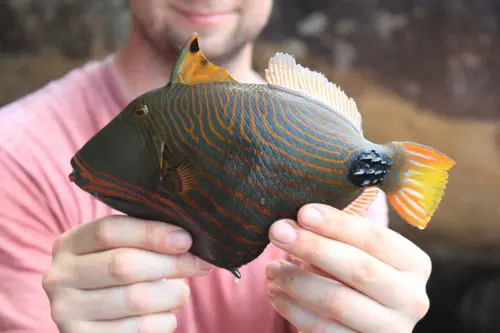
Cá Bò Đen

Balistapus undulatus (Park, 1797)

WoRMS — Tên hợp lệ trên WoRMS
Tên được xác nhận
Xem trên WoRMS (marinespecies.org)

Thông tin chính

Tên gọi khác
Cá Bò da Đen, Cá Bò gai Đen
Common Name (EN)
Orange lined triggerfish
Kích thước
Lớn nhất 30cm.
Size
Maximum 30cm.

Mô tả hình thái

Adults which are territorial in nature occur in coral-rich areas of deep lagoon and seaward reefs from the lower surge zone to at least 50 meters (Ref. 48637). They feed on a variety of benthic organisms such as algae, echinoderms, fishes, mollusks, tunicates, sponges, and hydrozoans. Eggs are laid as one cluster in a shallow excavation on sand or rubble along channels. (Ref. 1602). Marketed fresh and dried-salted (Ref. 9770).EN · FishBase/GBIF

Sinh thái & Dinh dưỡng

Habitat: Coral reefs, Rocky. Feeding: hunting macrofauna (predator). Depth range: 0 - 60 m. Occurs in coral-rich (Ref. 58534) areas of deep lagoon and seaward reefs from the lower surge zone to at least 50 meters (Ref. 48637). Feeds on a variety of benthic organisms such as algae, coral, molluscs, worms, echinoderms, fishes, mollusks, tunicates, sponges, and hydrozoans (Ref. 54301). Has a territorial nature. They seek shelter in coral crevices when threatened or when retiring for the night.EN · FishBase/GBIF

Phân bố

Biển Đỏ, Ốttrâylia, Inđônêxia, Malaixia, Philíppin, Guam, Carôlin, Marsal, Samoa, Xôxiêty, Thái Lan, Trung Quốc, Đài Loan, Nhật bản. Vịnh Bắc Bộ, Miền Trung, Nam Bộ, Quần đảo Trường Sa (Việt Nam)

Giá trị kinh tế

Commercial importance: commercial. Price category: medium. Aquaculture: never/rarely. Vulnerability index: 20.0/100EN · FishBase/GBIF

Mẫu vật & Tài liệu

Nơi lưu trữ mẫu
Viện Hải Dương Học (Nha Trang).
Specimen
Institute of Oceanography (Nha Trang).
Tình trạng
Thường gặp, số lượng ít.
Status
Common, seldom abundant.
Tài liệu dẫn
Herre, 1953. Chu Nguyên Đỉnh, 1962. De Beaufort and Briggs, 1962. Shen, 1993.
Literature
Herre, 1953. Chu, 1962. De Beaufort and Briggs, 1962. Shen, 1993.

Sinh học — Sinh thái BIO

Tên tiếng Anh (FishBase)
Orange-lined triggerfish
English name (FishBase)
Orange-lined triggerfish
Chiều dài tối đa
30.0 cm TL
Max length
30.0 cm TL
Độ sâu phân bố
0 - 60 m
Depth range
0 - 60 m
Môi trường sống
Coral reefs, Rocky
Habitat
Coral reefs, Rocky
Nguy hiểm cho người
Gây thương tích cơ học
Danger to humans
traumatogenic
Kiểu ăn
Săn mồi lớn (ăn thịt)
Feeding type
hunting macrofauna (predator)
Hình thức sinh sản
Phân giới tính, thụ tinh ngoài
Reproduction
dioecism, external fertilization
Chăm sóc con
biparental
Parental care
biparental
Giá trị thương mại
Thương mại
Importance
commercial
Nuôi trồng thủy sản
Không/hiếm khi
Aquaculture
never/rarely

Ghi chú chi tiết

Tóm tắt sinh học (FishBase)(Biology summary (FishBase))

Cá trưởng thành có tập tính bảo vệ lãnh thổ, phân bố tại các khu vực giàu san hô ở đầm phá sâu và các rạn san hô hướng biển, từ vùng sóng vỗ thấp đến độ sâu ít nhất 50 mét (Ref. 48637). Chúng ăn nhiều loài sinh vật đáy khác nhau như tảo, động vật da gai, cá, động vật thân mềm, hải tiêu, bọt biển và ngành thủy tức. Trứng được đẻ thành một ổ trong một hố nông trên nền cát hoặc mảnh vụn san hô dọc theo các rãnh nước (Ref. 1602). Loài này được thương mại dưới dạng tươi sống và khô muối (Ref. 9770).

Xem văn bản gốc tiếng Anh (FishBase / GBIF)

Adults which are territorial in nature occur in coral-rich areas of deep lagoon and seaward reefs from the lower surge zone to at least 50 meters (Ref. 48637). They feed on a variety of benthic organisms such as algae, echinoderms, fishes, mollusks, tunicates, sponges, and hydrozoans. Eggs are laid as one cluster in a shallow excavation on sand or rubble along channels. (Ref. 1602). Marketed fresh and dried-salted (Ref. 9770).

Ghi chú sinh thái(Ecology notes)

Phân bố tại các khu vực giàu san hô (Ref. 58534) ở đầm phá sâu và các rạn san hô hướng biển, từ vùng sóng vỗ thấp đến độ sâu ít nhất 50 mét (Ref. 48637). Thức ăn chủ yếu gồm nhiều loài sinh vật đáy như tảo, san hô, động vật thân mềm, giun, động vật da gai, cá, hải tiêu, bọt biển và ngành thủy tức (Ref. 54301). Có tập tính bảo vệ lãnh thổ. Chúng thường tìm nơi trú ẩn trong các kẽ hở san hô khi gặp nguy hiểm hoặc khi nghỉ ngơi vào ban đêm.

Xem văn bản gốc tiếng Anh (FishBase / GBIF)

Occurs in coral-rich (Ref. 58534) areas of deep lagoon and seaward reefs from the lower surge zone to at least 50 meters (Ref. 48637). Feeds on a variety of benthic organisms such as algae, coral, molluscs, worms, echinoderms, fishes, mollusks, tunicates, sponges, and hydrozoans (Ref. 54301). Has a territorial nature. They seek shelter in coral crevices when threatened or when retiring for the night.

Ghi chú sinh sản(Reproduction notes)

Hành vi sinh sản có thể diễn ra theo các nhóm lỏng lẻo và việc làm ổ diễn ra ở các rãnh nước. Trứng được đẻ thành một khối xốp duy nhất trong một hố nông trên nền cát hoặc mảnh vụn san hô. Trứng nở vào ban đêm (Ref. 37816). Tổ được bảo vệ bởi một hoặc đôi khi hai cá thể trưởng thành (Ref. 9778).

Xem văn bản gốc tiếng Anh (FishBase / GBIF)

Spawning behaviour may involve loose aggregations and nesting occurs in channels. The eggs are laid in a single spongy cluster in a shallow excavation in rubble or sand. Hatching occurs at night (Ref. 37816). Nests are guarded by one or at times two adults (Ref. 9778).

Danh pháp đồng nghĩa & Phân loại gốc

Balistes undulatus Mungo Park, Trans. Linn. Soc. London, Vol.3, p.37, 1797. Gunther, 1870. Day, 1889. De Beaufort and Briggs, 1962.
Balistes linneatus Bloch and Schneider, Syst. Ichth., p.466, pl.87, 1801. Meyer, 1885.
Balistes lamourouxii Quoy and Gaimard, Voy. Uranie, Zool., Vol.1, p.208, pl.47, fig.1, 1824.
Balistes sesquilineatus Lay and Bennett, Fishes zool. Capt. Beechey's Voy., p.69, pl.21, fig.3, 1839.
Balistes (Balistapus) lineatus Bleeker, Atlas Ichth., Vol.5, p.118, pl.229, fig.2, 1865.
Balistapus undulatus Fowler, Proc. Acad. Nat. Sci. Phila., p.496, 1899. Seale, 1906. Jordan and Seale, 1907. Evermann and Seale, 1907. Jordan and Richardson, 1908. Kendall, 1911. Fowler, 1927. Chu, 1931. Herre, 1934. Komohara, 1940. Smith, 1953. Matsubara, 1955. Chu, 1962. Shen, 1993.
Balispapus lineatus Fowler and Bean, Proc. U.S. Nat. Mus., Vol.62, p.59, 1922.