
Quay lại danh sách
#186Tập 5

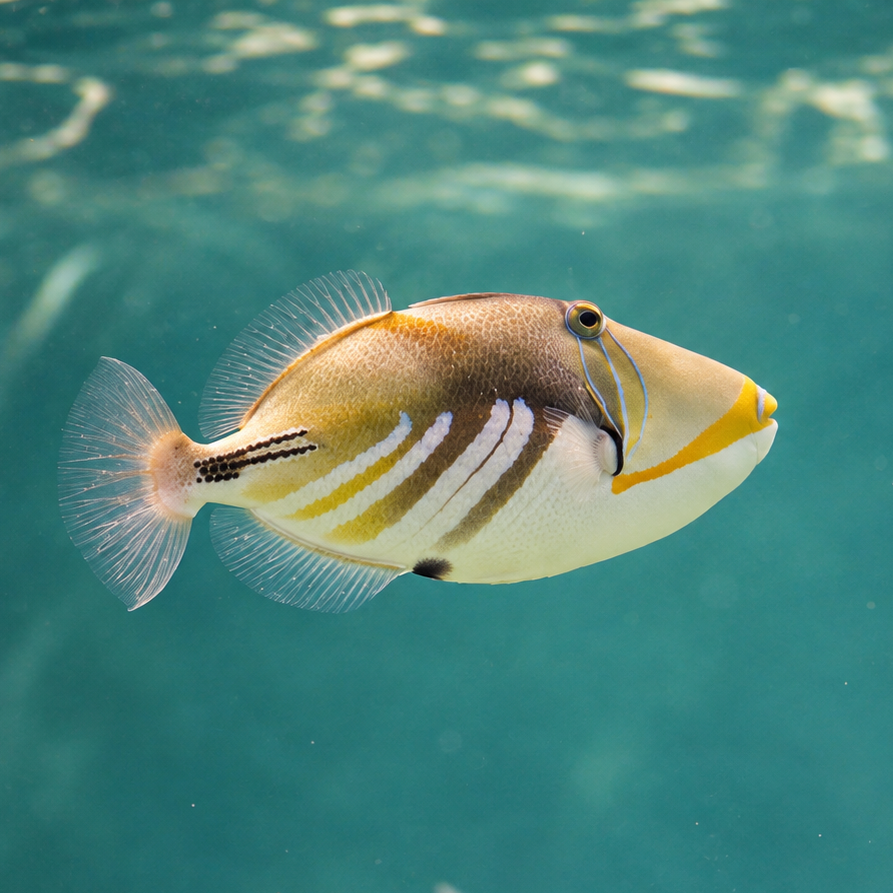
Cá Bò Da Gai

Rhinecanthus aculeatus (Linnaeus, 1758)

WoRMS — Tên hợp lệ trên WoRMS
Tên được xác nhận
Xem trên WoRMS (marinespecies.org)

Thông tin chính

Tên gọi khác
Cá Bò gai Gai, Cá Bò rạn Gai
Common Name (EN)
White banded triggerfish
Kích thước
Lớn nhất 25cm.
Size
Maximum 25cm.

Mô tả hình thái

Commonly found in subtidal reef flats and shallow protected lagoons, Ref. 48637. Benthopelagic (Ref. 58302). Juveniles secretive with rubble patches, adults swim about openly but are usually shy (Ref. 48637). Territorial. Feed on algae, detritus, mollusks, crustaceans, worms, sea urchins, fishes, corals, tunicates, forams, and eggs (Ref. 3921). Oviparous (Ref. 205). Sleep on its side; makes a whirring noise when alarmed (Ref. 4420). Also caught with drive-in nets and is considered a popular aquarium fish (Ref. 9770).EN · FishBase/GBIF

Sinh thái & Dinh dưỡng

Habitat: Estuaries, Coral reefs, Soft bottom. Feeding: hunting macrofauna (predator). Depth range: 0 - 50 m. Commonly found in subtidal reef flats and shallow protected lagoons. Territorial. Feed on algae, detritus, mollusks, crustaceans, worms, sea urchins, fishes, corals, tunicates, forams, and eggs (Ref. 3921). Also caught with drive-in nets and is considered a popular aquarium fish (Ref. 9770).EN · FishBase/GBIF

Phân bố

Phía Đông Châu Phi, Ấn Độ, Xri Lanca, Ốttrâylia, Inđônêxia, Malaixia, Philíppin, Trung Quốc, Đài Loan, Haoai, Phigi, Thái Lan, Niu Calêđônia. Miền Trung, Quần đảo Trường Sa (Việt Nam).

Giá trị kinh tế

Commercial importance: minor commercial. Price category: medium. Aquaculture: never/rarely. Vulnerability index: 29.81/100EN · FishBase/GBIF

Mẫu vật & Tài liệu

Nơi lưu trữ mẫu
Viện Hải Dương Học (Nha Trang).
Specimen
Institute of Oceanography (Nha Trang).
Tình trạng
Thường gặp, số lượng ít.
Status
Common, seldom abundant.
Tài liệu dẫn
Herre, 1953. Chu Nguyên Đỉnh, 1962. De Beaufort and Briggs, 1962. Shen, 1993.
Literature
Herre, 1953. Chu, 1962. De Beaufort and Briggs, 1962. Shen, 1993.

Sinh học — Sinh thái BIO

Tên tiếng Anh (FishBase)
White-banded triggerfish
English name (FishBase)
White-banded triggerfish
Chiều dài tối đa
30.0 cm TL
Max length
30.0 cm TL
Độ sâu phân bố
0 - 50 m
Depth range
0 - 50 m
Môi trường sống
Estuaries, Coral reefs, Soft bottom
Habitat
Estuaries, Coral reefs, Soft bottom
Nguy hiểm cho người
reports of ciguatera poisoning
Danger to humans
reports of ciguatera poisoning
Kiểu ăn
Săn mồi lớn (ăn thịt)
Feeding type
hunting macrofauna (predator)
Bậc dinh dưỡng
3.21
Trophic level
3.21
Hình thức sinh sản
Phân giới tính, thụ tinh ngoài
Reproduction
dioecism, external fertilization
Chăm sóc con
maternal
Parental care
maternal
Giá trị thương mại
Thương mại nhỏ
Importance
minor commercial
Nuôi trồng thủy sản
Không/hiếm khi
Aquaculture
never/rarely

Ghi chú chi tiết

Tóm tắt sinh học (FishBase)(Biology summary (FishBase))

Thường phân bố ở các bãi rạn vùng dưới triều và các đầm phá nông được che chắn (Ref. 48637). Sống ở tầng trung - đáy (Ref. 58302). Cá con có tập tính ẩn náu kỹ trong các đám vụn xác rạn, trong khi cá trưởng thành bơi lội tự do ngoài không gian nhưng thường nhút nhát (Ref. 48637). Có tính lãnh thổ. Thức ăn bao gồm tảo, mùn bã hữu cơ, động vật thân mềm, động vật giáp xác, giun, cầu gai, cá, san hô, động vật có áo, trùng lỗ và trứng (Ref. 3921). Loài đẻ trứng (Ref. 205). Có tập tính nằm nghiêng khi ngủ; phát ra tiếng kêu vo vo khi bị hoảng sợ (Ref. 4420). Cũng được đánh bắt bằng lưới quây và là một loài cá cảnh rất được ưa chuộng (Ref. 9770).

Xem văn bản gốc tiếng Anh (FishBase / GBIF)

Commonly found in subtidal reef flats and shallow protected lagoons, Ref. 48637. Benthopelagic (Ref. 58302). Juveniles secretive with rubble patches, adults swim about openly but are usually shy (Ref. 48637). Territorial. Feed on algae, detritus, mollusks, crustaceans, worms, sea urchins, fishes, corals, tunicates, forams, and eggs (Ref. 3921). Oviparous (Ref. 205). Sleep on its side; makes a whirring noise when alarmed (Ref. 4420). Also caught with drive-in nets and is considered a popular aquarium fish (Ref. 9770).

Ghi chú sinh thái(Ecology notes)

Thường phân bố ở các bãi rạn vùng dưới triều và các đầm phá nông được che chắn. Có tính lãnh thổ. Thức ăn bao gồm tảo, mùn bã hữu cơ, động vật thân mềm, động vật giáp xác, giun, cầu gai, cá, san hô, động vật có áo, trùng lỗ và trứng (Ref. 3921). Cũng được đánh bắt bằng lưới quây và là một loài cá cảnh rất được ưa chuộng (Ref. 9770).

Xem văn bản gốc tiếng Anh (FishBase / GBIF)

Commonly found in subtidal reef flats and shallow protected lagoons. Territorial. Feed on algae, detritus, mollusks, crustaceans, worms, sea urchins, fishes, corals, tunicates, forams, and eggs (Ref. 3921). Also caught with drive-in nets and is considered a popular aquarium fish (Ref. 9770).

Ghi chú sinh sản(Reproduction notes)

Tạo cặp rõ rệt (Ref. 205). Hệ thống giao phối có thể là sự kết hợp giữa đa thê, một vợ một chồng và khả năng giao phối bừa bãi ở các cá thể cái sống đơn độc, tuy nhiên hệ thống giao phối chính được xem xét cho loài này là đa thê (Ref. 116439). Cá cái có tính lãnh thổ, chỉ có cá cái chăm sóc và bảo vệ trứng (Ref. 116451). Cá đực thể hiện tính đa thê (Ref. 116451).

Xem văn bản gốc tiếng Anh (FishBase / GBIF)

Distinct pairing (Ref. 205). Mating system may be a mixture of polygyny, monogamy, and potential promiscuity in solitary females but the primary mating system considered for this species is polygyny (Ref. 116439). Females are territorial, solely tending and guarding the eggs (Ref. 116451). Males exhibit polygyny (Ref. 116451).

Danh pháp đồng nghĩa & Phân loại gốc

Balistes aculeatus Linnaeus, Syst. Nat. ed.10, p.328, 1758. Bloch, 1786. Lay and Bennett, 1839. Bleeker, 1848. Gunther, 1878. Day, 1878. De Beaufort and Briggs, 1962.
Balistes ornatissimus Lesson, Voy. Coquille zool., Vol.2, p.119, 1830.
Balistapus aculeatus Fowler, Proc. Acad. Nat. Sci. Phila., p.496, 1899. Seale, 1900. Bryan and Herre, 1903. Seale, 1906. Jordan and Evermann, 1907. Jordan and Richardson, 1908. Kendall, 1911. Weber, 1913. Chu, 1931. Herre, 1953. Matsubara, 1955. Chu Nguyên Đỉnh, 1962.
Balistes (Balistapus) heteracanthus Bleeker, Atlas Ichth., Vol.5, p.117, pl.(4), 218, fig.1, 1865.
Monacanthus cheverti Alleyne and Macleay, Proc. Lin. Soc. New S. Wales, Vol. 2, p. 69, 1877.
Rhinecanthus aculeatus Smith, Sea fishes of Southern Africa, p.410, pl.91, fig.1169, 1953.