
Quay lại danh sách
#226Tập 5

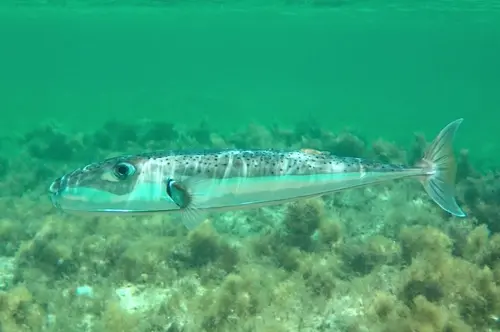
Cá Nóc Chấm Tròn

Lagocephalus sceleratus (Gmelin, 1789)

WoRMS — Tên hợp lệ trên WoRMS
Tên được xác nhận
Xem trên WoRMS (marinespecies.org)

Thông tin chính

Tên gọi khác
Cá Cóc biển Chấm Tròn, Cá Nóc gai Chấm Tròn
Common Name (EN)
Silverstrip blaasop
Kích thước
Lớn nhất 85cm.
Size
Maximum 85cm.

Mô tả hình thái

Lagocephalus sceleratus was found at seafloor depths of 10, 25, and 75 m in all regions. The highest biomass was 135 kg / km 2 in February and the highest abundance was 150 ind / km 2 in October and February, particularly obvious in R 1 (Fig. 2). Populations were dominated by males May – October, while females were abundant mainly in February. Biomass did not differ significantly among regions, seasons, and bottom depths (ANOVA, p = 0.675, 0.373, and 0.780, respectively). The highest biomass was highest in R 1 (X ± SD: 5.43 ± 3.10 kg / km 2) and lowest in R 3 (0.03 ± 3.16 kg / km 2, Fig. 2). Biomass increased from a minimum in May (0.13 ± 3.34 kg / km 2) and August (0.46 ± 3.79 kg / km 2) to a maximum in October (1.74 ± 3.41 kg / km 2) and February (7.97 ± 3.59 kg / km 2). Biomass increased with depth: 0.97 ± 4.12 kg / km 2 at 10 m, 3.69 ± 4.43 kg / km 2 at 25 m and 9.72 ± 4.27 kg / km 2 at 75 m (Fig. 2 A). Abundance of L. sceleratus did not differ significantly among regions, seasons (months), and depths (p = 0.252, 0.215, and 0.269, respectively). Maximum abundance was found in R 1 (17.35 ± 5.28 ind / km 2) and R 4 (13.20 ± 12.04 ind / km 2) and minimum abundance in R 2 (3.43 ± 5.61 ind / km 2) and R 3 (4.92 ± 5.38 ind / km 2). Abundance increased gradually from May (1.77 ± 5.73 ind / km 2) through August (3.88 ± 6.51 ind / km 2), and experienced abrupt spikes in October (13.90 ± 5.86 ind / km 2) and February (16.95 ± 6.16 ind / km 2). In contrast to biomass, abundance decreased with depth from 20.40 ± 6.91 ind / km 2 at 10 – 25 m to 11.36 ± 7.16 ind / km 2 at 75 m (Fig. 2 B). Sex ratios did not differ significantly among regions, seasons, and depths (p = 0.338, 0.718, and 0.909, respectively); however, an increase in p values from west (0.09 ± 0.22) to east (1.00 ± 0.44) was observed suggesting strength of dominance of the females. Females were mostly absent in May and August, whereas the ratio of females: males was twice as high in October (0.50 ± 0.25) than in EN · FishBase/GBIF

Sinh thái & Dinh dưỡng

Habitat: Coral reefs, Benthic, Soft bottom, Rocky. Feeding: hunting macrofauna (predator). Depth range: 18 - 100 m. Inhabits offshore reefs (Ref. 9563). Demersal fish and a carnivore (Ref. 42247). Feeds on benthic invertebrates. Dwells in benthic sandy substrates (Ref. 127989). Inhabits shallow waters, over scattered reefs and rocky areas. Scavenger. Feeds on encrusting organisms and floating detritus (Ref. 9773).EN · FishBase/GBIF

Phân bố

Đông Châu Phi, Mauritiux, Biển Đỏ, Ấn Độ, Xri Lanca, Niu Ghinê, Phigi, Ốttrâylia, Inđônêxia, Malaixia, Thái Lan, Philíppin, Trung Quốc, Đài Loan, Nhật Bản. Vịnh Bắc Bộ, Miền Trung, Nam Bộ.

Giá trị kinh tế

Commercial importance: of no interest. Aquaculture: never/rarely. Vulnerability index: 40.34/100EN · FishBase/GBIF

Mẫu vật & Tài liệu

Nơi lưu trữ mẫu
Viện Hải Dương Học Nha Trang.
Specimen
Institute of Oceanography (Nha Trang).
Tình trạng
Thường gặp.
Status
Common.
Tài liệu dẫn
Matsubara, 1955. De Beaufort and Briggs, 1962. Masuda and all, 1984. Mai Đình Yên và Nguyễn Văn Trọng, 1992. Shen, 1993.
Literature
Matsubara, 1955. De Beaufort and Briggs, 1962. Masuda and all, 1984. Mai and Nguyen, 1992. Shen, 1993.

Sinh học — Sinh thái BIO

Tên tiếng Anh (FishBase)
Silver-cheeked toadfish
English name (FishBase)
Silver-cheeked toadfish
Chiều dài tối đa
110.0 cm TL
Max length
110.0 cm TL
Trọng lượng tối đa
9,000 g
Max weight
9,000 g
Độ sâu phân bố
18 - 100 m
Depth range
18 - 100 m
Môi trường sống
Coral reefs, Benthic, Soft bottom, Rocky
Habitat
Coral reefs, Benthic, Soft bottom, Rocky
Nguy hiểm cho người
Độc khi ăn
Danger to humans
poisonous to eat
Kiểu ăn
Săn mồi lớn (ăn thịt)
Feeding type
hunting macrofauna (predator)
Bậc dinh dưỡng
3.70
Trophic level
3.70
Hình thức sinh sản
Phân giới tính, thụ tinh ngoài
Reproduction
dioecism, external fertilization
Giá trị thương mại
Không có giá trị
Importance
of no interest
Nuôi trồng thủy sản
Không/hiếm khi
Aquaculture
never/rarely

Ghi chú chi tiết

Tóm tắt sinh học (FishBase)(Biology summary (FishBase))

Sinh sống tại các rạn san hô xa bờ. Sống ở đáy cát. Thường bị bắt bằng lưới ba màng. Loài này chứa độc tố tetrodotoxin có thể gây ngộ độc thực phẩm; Trung tâm Thông tin Ngộ độc Israel đã ghi nhận 13 trường hợp vào tháng 12 năm 2008 đều có liên quan đến việc tiêu thụ loài cá này.

Xem văn bản gốc tiếng Anh (FishBase / GBIF)

Inhabits offshore reefs (Ref. 9563). Sandy bottom (Ref. 95646). Caught by trammel net (Ref. 96695). This species contains tetrodotoxin which may be a source for food poisoning and the Israel Poison Information center registered 13 cases in December 2008 where all were related to the consumption of this fish (Ref. 118670).

Ghi chú sinh thái(Ecology notes)

Sinh sống tại các rạn san hô xa bờ. Là loài cá tầng đáy và ăn thịt. Thức ăn chủ yếu gồm các loài động vật không xương sống ở đáy. Sống vùi ở các sinh cảnh đáy cát. Phân bố ở vùng nước nông, trên các rạn san hô rải rác và các khu vực đá. Là loài ăn tạp (xác sinh vật). Chuyên ăn các sinh vật bám và vụn hữu cơ lơ lửng.

Xem văn bản gốc tiếng Anh (FishBase / GBIF)

Inhabits offshore reefs (Ref. 9563). Demersal fish and a carnivore (Ref. 42247). Feeds on benthic invertebrates. Dwells in benthic sandy substrates (Ref. 127989). Inhabits shallow waters, over scattered reefs and rocky areas. Scavenger. Feeds on encrusting organisms and floating detritus (Ref. 9773).

Ghi chú sinh sản(Reproduction notes)

Đẻ trứng.

Xem văn bản gốc tiếng Anh (FishBase / GBIF)

Oviparous (Ref. 205).

Mô tả hình thái (GBIF)(Morphological description (GBIF))

Lagocephalus sceleratus được tìm thấy ở các độ sâu đáy biển 10, 25 và 75 m ở tất cả các vùng. Sinh khối cao nhất đạt 135 kg/km2 vào tháng 2 và mật độ phong phú cao nhất đạt 150 cá thể/km2 vào tháng 10 và tháng 2, đặc biệt rõ rệt tại R1 (Hình 2). Quần thể chiếm ưu thế bởi cá đực từ tháng 5 đến tháng 10, trong khi cá cái dồi dào chủ yếu vào tháng 2. Sinh khối không có sự khác biệt có ý nghĩa thống kê giữa các vùng, các mùa và độ sâu đáy (phân tích ANOVA, p lần lượt là 0,675; 0,373 và 0,780). Sinh khối cao nhất tại R1 (X ± SD: 5,43 ± 3,10 kg/km2) và thấp nhất tại R3 (0,03 ± 3,16 kg/km2, Hình 2). Sinh khối tăng từ mức tối thiểu vào tháng 5 (0,13 ± 3,34 kg/km2) và tháng 8 (0,46 ± 3,79 kg/km2) đến mức tối đa vào tháng 10 (1,74 ± 3,41 kg/km2) và tháng 2 (7,97 ± 3,59 kg/km2). Sinh khối tăng theo độ sâu: 0,97 ± 4,12 kg/km2 ở độ sâu 10 m, 3,69 ± 4,43 kg/km2 ở 25 m và 9,72 ± 4,27 kg/km2 ở 75 m (Hình 2 A). Mật độ của L. sceleratus không có sự khác biệt có ý nghĩa thống kê giữa các vùng, các mùa (tháng) và độ sâu (p lần lượt là 0,252; 0,215 và 0,269). Mật độ tối đa được tìm thấy ở R1 (17,35 ± 5,28 cá thể/km2) và R4 (13,20 ± 12,04 cá thể/km2), mật độ tối thiểu ở R2 (3,43 ± 5,61 cá thể/km2) và R3 (4,92 ± 5,38 cá thể/km2). Mật độ tăng dần từ tháng 5 (1,77 ± 5,73 cá thể/km2) qua tháng 8 (3,88 ± 6,51 cá thể/km2), và tăng vọt vào tháng 10 (13,90 ± 5,86 cá thể/km2) và tháng 2 (16,95 ± 6,16 cá thể/km2). Trái ngược với sinh khối, mật độ giảm theo độ sâu từ 20,40 ± 6,91 cá thể/km2 ở độ sâu 10 – 25 m xuống 11,36 ± 7,16 cá thể/km2 ở 75 m (Hình 2 B). Tỷ lệ giới tính không khác biệt có ý nghĩa giữa các vùng, mùa và độ sâu (p lần lượt là 0,338; 0,718 và 0,909); tuy nhiên, sự gia tăng giá trị p từ phía tây (0,09 ± 0,22) sang phía đông (1,00 ± 0,44) đã được quan sát thấy, cho thấy mức độ chiếm ưu thế của cá cái. Cá cái hầu như vắng mặt vào tháng 5 và tháng 8, trong khi tỷ lệ cá cái so với cá đực cao gấp đôi vào tháng 10 (0,50 ± 0,25) so với...

Xem văn bản gốc tiếng Anh (FishBase / GBIF)

Lagocephalus sceleratus was found at seafloor depths of 10, 25, and 75 m in all regions. The highest biomass was 135 kg / km 2 in February and the highest abundance was 150 ind / km 2 in October and February, particularly obvious in R 1 (Fig. 2). Populations were dominated by males May – October, while females were abundant mainly in February. Biomass did not differ significantly among regions, seasons, and bottom depths (ANOVA, p = 0.675, 0.373, and 0.780, respectively). The highest biomass was highest in R 1 (X ± SD: 5.43 ± 3.10 kg / km 2) and lowest in R 3 (0.03 ± 3.16 kg / km 2, Fig. 2). Biomass increased from a minimum in May (0.13 ± 3.34 kg / km 2) and August (0.46 ± 3.79 kg / km 2) to a maximum in October (1.74 ± 3.41 kg / km 2) and February (7.97 ± 3.59 kg / km 2). Biomass increased with depth: 0.97 ± 4.12 kg / km 2 at 10 m, 3.69 ± 4.43 kg / km 2 at 25 m and 9.72 ± 4.27 kg / km 2 at 75 m (Fig. 2 A). Abundance of L. sceleratus did not differ significantly among regions, seasons (months), and depths (p = 0.252, 0.215, and 0.269, respectively). Maximum abundance was found in R 1 (17.35 ± 5.28 ind / km 2) and R 4 (13.20 ± 12.04 ind / km 2) and minimum abundance in R 2 (3.43 ± 5.61 ind / km 2) and R 3 (4.92 ± 5.38 ind / km 2). Abundance increased gradually from May (1.77 ± 5.73 ind / km 2) through August (3.88 ± 6.51 ind / km 2), and experienced abrupt spikes in October (13.90 ± 5.86 ind / km 2) and February (16.95 ± 6.16 ind / km 2). In contrast to biomass, abundance decreased with depth from 20.40 ± 6.91 ind / km 2 at 10 – 25 m to 11.36 ± 7.16 ind / km 2 at 75 m (Fig. 2 B). Sex ratios did not differ significantly among regions, seasons, and depths (p = 0.338, 0.718, and 0.909, respectively); however, an increase in p values from west (0.09 ± 0.22) to east (1.00 ± 0.44) was observed suggesting strength of dominance of the females. Females were mostly absent in May and August, whereas the ratio of females: males was twice as high in October (0.50 ± 0.25) than in

Danh pháp đồng nghĩa & Phân loại gốc

Tetraodon sceleratus Gmelin, Linne Syst. Nat., p.1444, 1788. Bleeker, 1852.
Tetrodon sceleratus Bloch and Schneider, Syst. Ichth., p.506, 1801. Lichtenstein, 1944. Gunther, 1870. Klunzinger, 1871. Day, 1878. Macleay, 1881. Barnard, 1927.
Tetrodon argenteus Lacépède, Ann. Mus. Hist. Nat., Vol.4, p.211, 1804. Schlegel, 1850. Bleeker, 1952.
Tetrodon argyropleura Bennett, Comm. Zool. Soc. London, Vol.2, p.184, 1832.
Gastrophysus argenteus Bleeker, Verh. Akad Amsterdam, Vol.2, p.16, 11855.
Tetraodon argenteus Bleeker, Atlas Ichth., Vol.5, p.64, 1865.
Spheroides sceleratus Jordan and Evermann, Proc. U.S. Nat. Mus., Vol.24, p.359, 1902. Mc-Culloch, 1922. Herre, 1924. Fowler, 1928. Schmidt, 1930. Boeseman, 1947.
Pleuranacanthus sceleratus Whitley, Rec. Austr. Mus., Vol.19, p.106, 1933.
Lagocephalus sceleratus Blegvad, Danish Inv. Iran, Part 3, p.218, 1944. Liang, 1848.
Gastrophysus sceleratus Smith, The Sea Fishes of South Africa, p.418, 1950. Munro, 1955. Mai Đình Yên và Nguyễn Văn Trọng, 1992.