
Quay lại danh sách
#91Tập 5

Cá Bơn Vằn Răng To

Pseudorhombus arsius (Hamilton, 1822)

WoRMS — Tên hợp lệ trên WoRMS
Tên được xác nhận
Xem trên WoRMS (marinespecies.org)

Thông tin chính

Tên gọi khác
Cá Danh
Common Name (EN)
Largetooth flounder
Kích thước
110 - 275mm. Lớn nhất 450mm.
Size
110 - 275mm. Maximum 450mm.

Mô tả hình thái

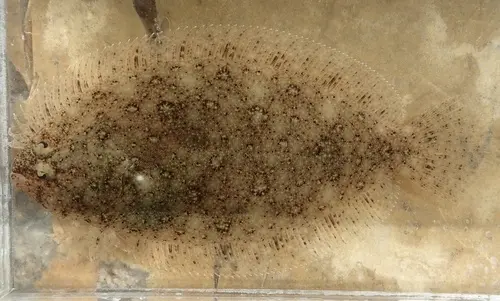
Diagnosis: The species can be diagnosed by having lateral line on both sides, with ctenoid scales on the eyed side and cycloid scales on the blind side. The eyed side has two eye-like dark spots on the lateral line. Numerous greenish-white cloudy spots are visible in live. The teeth on the lower jaw are 10 – 12. On blind side if the straight part of the lateral line extended forward, it passes well above upper eye. Total vertebrae: 34 – 35. The details of body ratio and morpho-meristic counts are given in (Table 1 – 2). Colour: The whole body is creamy brown in colour. The blind side of the body is white in colour. There are two dark, eye-like black spots on the eyed side lateral line. One is just at the junction of curved and straight part of LL, and the other one is just at the one-third portion of the body on the upper edge of lateral line. There are numerous cloudy spots on the eyed side, which colour varies from light green to dark whitish. This colouration changes after 2 to 3 hours of death or preservation. A few black small melanophores are visible in whole body and as well as in dorsal, anal, caudal and pectoral fins.EN · FishBase/GBIF

Sinh thái & Dinh dưỡng

Habitat: Neritic, Estuaries, Mangroves, Benthic, Soft bottom, Mud, Rocky. Feeding: hunting macrofauna (predator). Depth range: 0 - 200 m. Euryhaline species. Prefers muddy, sandy or gravel bottom. Juveniles can make extensive use of estuaries and inhabit mangrove swamps. Both juveniles and adults can be found in the intertidal, on muddy and sandy bottoms and near mangrove and seagrass beds (Ref. 121944). Dwells in shallow, muddy substrates where it burrows into mud or sand, leaving only its eyes exposed. Ambush predator. Feeds on crabs, marine worms, and small fishes. Larvae resemble regular fishes and inhabits the water column. Eventually, its right eye migrates towards the left side and its skull twists as it transforms into its benthic adult stage (Ref. 9773).EN · FishBase/GBIF

Phân bố

Đông Châu Phi, Đông Ấn Độ Dương, Ấn Độ, Inđônêxia, Malaixia, Thái Lan, Philíppin, Trung Quốc, Đài Loan, Nhật Bản. Vịnh Bắc Bộ, Miền Trung Việt Nam, Nam Bộ.

Giá trị kinh tế

Commercial importance: commercial. Price category: very high. Aquaculture: never/rarely. Vulnerability index: 49.22/100EN · FishBase/GBIF

Mẫu vật & Tài liệu

Nơi lưu trữ mẫu
Viện Hải Dương Học (Nha Trang).
Specimen
Institute of Oceanography (Nha Trang).
Tình trạng
Thường gặp, tương đối nhiều.
Status
Common, relatively numerous.
Tài liệu dẫn
Weber and De Beaufort, 1929. Herre, 1953. Zheng, 1962. Orsi, 1974. Shen, 1993.
Literature
Weber and De Beaufort, 1929. Herre, 1953. Zheng, 1962. Orsi, 1974. Shen, 1993.

Sinh học — Sinh thái BIO

Tên tiếng Anh (FishBase)
Largetooth flounder
English name (FishBase)
Largetooth flounder
Chiều dài tối đa
45.0 cm TL
Max length
45.0 cm TL
Độ sâu phân bố
0 - 200 m
Depth range
0 - 200 m
Môi trường sống
Neritic, Estuaries, Mangroves, Benthic, Soft bottom, Mud, Rocky
Habitat
Neritic, Estuaries, Mangroves, Benthic, Soft bottom, Mud, Rocky
Nguy hiểm cho người
Vô hại
Danger to humans
harmless
Kiểu ăn
Săn mồi lớn (ăn thịt)
Feeding type
hunting macrofauna (predator)
Bậc dinh dưỡng
4.16
Trophic level
4.16
Hình thức sinh sản
Phân giới tính, thụ tinh ngoài
Reproduction
dioecism, external fertilization
Giá trị thương mại
Thương mại
Importance
commercial
Nuôi trồng thủy sản
Không/hiếm khi
Aquaculture
never/rarely

Ghi chú chi tiết

Tóm tắt sinh học (FishBase)(Biology summary (FishBase))

Phân bố ở vùng nước nông và vùng cửa sông, trên nền đáy bùn và cát, với độ sâu tới 200 m (Ref. 30573). Cá con thường xuất hiện ở vùng nước lợ (Ref. 9774). Thức ăn chủ yếu gồm các loài động vật đáy (Ref. 5213). Chủ yếu được tiêu thụ dạng tươi sống (Ref. 9774).

Xem văn bản gốc tiếng Anh (FishBase / GBIF)

Found in shallow waters and estuaries, on mud and sand bottoms, to depths of 200 m (Ref. 30573). Juveniles common in brackish water (Ref. 9774). Feeds on benthic animals (Ref. 5213). Mainly sold fresh (Ref. 9774).

Ghi chú sinh thái(Ecology notes)

Là loài rộng muối. Ưa sống trên nền đáy bùn, cát hoặc sỏi. Cá con có thể sử dụng rộng rãi các vùng cửa sông và sinh sống trong các đầm lầy rừng ngập mặn. Cả cá con và cá trưởng thành đều có thể tìm thấy ở vùng gian triều, trên nền đáy bùn, cát và gần các thảm rừng ngập mặn, thảm cỏ biển (Ref. 121944). Sống ở các tầng nền bùn nông, nơi chúng vùi mình vào bùn hoặc cát, chỉ để lộ đôi mắt. Là loài săn mồi kiểu phục kích. Thức ăn gồm cua, giun biển và các loài cá nhỏ. Ấu trùng có hình dạng giống cá đối xứng thông thường và sống ở cột nước. Cuối cùng, mắt phải di chuyển sang phía bên trái và hộp sọ xoắn lại khi chúng chuyển sang giai đoạn trưởng thành sống ở tầng đáy (Ref. 9773).

Xem văn bản gốc tiếng Anh (FishBase / GBIF)

Euryhaline species. Prefers muddy, sandy or gravel bottom. Juveniles can make extensive use of estuaries and inhabit mangrove swamps. Both juveniles and adults can be found in the intertidal, on muddy and sandy bottoms and near mangrove and seagrass beds (Ref. 121944). Dwells in shallow, muddy substrates where it burrows into mud or sand, leaving only its eyes exposed. Ambush predator. Feeds on crabs, marine worms, and small fishes. Larvae resemble regular fishes and inhabits the water column. Eventually, its right eye migrates towards the left side and its skull twists as it transforms into its benthic adult stage (Ref. 9773).

Ghi chú sinh sản(Reproduction notes)

Ghép đôi rõ rệt (Ref. 205).

Xem văn bản gốc tiếng Anh (FishBase / GBIF)

Distinct pairing (Ref. 205).

Mô tả hình thái (GBIF)(Morphological description (GBIF))

Chẩn loại: Loài này được nhận diện bởi sự hiện diện của đường bên ở cả hai phía cơ thể, với vảy lược ở phía có mắt và vảy tròn ở phía mù (không có mắt). Phía có mắt có hai đốm đen hình mắt kính nằm trên đường bên. Khi còn sống, có thể thấy rõ nhiều đốm mờ màu trắng lục. Hàm dưới có từ 10 – 12 chiếc răng. Ở phía mù, nếu kéo dài phần thẳng của đường bên về phía trước, đường này sẽ nằm phía trên mắt trên. Tổng số đốt sống: 34 – 35. Chi tiết về tỷ lệ cơ thể và các chỉ số hình thái - đếm được được trình bày trong (Bảng 1 – 2). Màu sắc: Toàn thân có màu nâu kem. Phía mù có màu trắng. Phía có mắt có hai đốm đen hình mắt kính nằm trên đường bên; một đốm nằm ngay tại điểm giao giữa phần cong và phần thẳng của đường bên, đốm còn lại nằm ở khoảng một phần ba chiều dài cơ thể trên mép trên của đường bên. Trên phía có mắt có nhiều đốm mờ, màu sắc biến đổi từ xanh nhạt đến trắng đục. Màu sắc này thay đổi sau 2 đến 3 giờ khi cá chết hoặc được ngâm bảo quản. Một số lượng ít tế bào sắc tố đen (melanophore) nhỏ xuất hiện rải rác trên toàn bộ cơ thể cũng như trên các vây lưng, vây hậu môn, vây đuôi và vây ngực.

Xem văn bản gốc tiếng Anh (FishBase / GBIF)

Diagnosis: The species can be diagnosed by having lateral line on both sides, with ctenoid scales on the eyed side and cycloid scales on the blind side. The eyed side has two eye-like dark spots on the lateral line. Numerous greenish-white cloudy spots are visible in live. The teeth on the lower jaw are 10 – 12. On blind side if the straight part of the lateral line extended forward, it passes well above upper eye. Total vertebrae: 34 – 35. The details of body ratio and morpho-meristic counts are given in (Table 1 – 2). Colour: The whole body is creamy brown in colour. The blind side of the body is white in colour. There are two dark, eye-like black spots on the eyed side lateral line. One is just at the junction of curved and straight part of LL, and the other one is just at the one-third portion of the body on the upper edge of lateral line. There are numerous cloudy spots on the eyed side, which colour varies from light green to dark whitish. This colouration changes after 2 to 3 hours of death or preservation. A few black small melanophores are visible in whole body and as well as in dorsal, anal, caudal and pectoral fins.

Danh pháp đồng nghĩa & Phân loại gốc

Pleuronectes arsius Hamilton (Buchanan), Fishes Ganges, p.128, 1822. Hora, 1929.
Platessa russelli Gray, Illustration Indian Zool., Vol.2, pl.94, fig.2, 1834.
Rhombus lentiginosus Richardson, Ann. Mag. Nat. Hist., Vol.11, p.495, 1843.
Platessa balteata Richardson, Ichth. China and Japan, p.278, 1846.
Rhombus polyspilus Bleeker, Nat. Tijds. Ned. Ind., Vol.4, p.503, 1853.
Rhombus arsius Bleeker, Verh. Bat. Gen., Vol.25, p.76, 1853.
Pseudorhombus polyspilus Bleeker, Versl. Akad. Amsterdam, Vol.124, p. 103, 1862. Jordan and Richardson, 1908. Weber and De Beaufort, 1929. Herre, 1934.
Pseudorhombus russelli Day, Fishes Malabar, p.172, 1865. Bleeker, 1866 - 1872. Gunther, 1880. Myers, 1885. Sauvage and Grandidier, 1920. Fowler, 1927.
Pseudorhombus lentiginosus Bleeker, Ned. Tijd Dierk., Vol.2, p.184, 1865.
Teratorhombus excisiceps Macleay, Proc. Linn. Soc. New South Wales, Vol.6, p.126, 1882.
Pleuronectes mortoniensis De Vis, Proc. Linn. Soc. New South Wales, Vol.7, p.370, 1883.
Pseudorhombus multimaculatus Myers, Ann. Soc. Espana Hist. Nat. Madrid, Vol.14, p.40, 1885.
Neorhombus ocellatus De Vis. Ann. Report Queensland Mus., 1886.
Paralichthys arsiusi Rutter, Proc. Acad. Nat. Sci. Phila., p.87, 1897. Waite, 1899.
Paralichthys polyspilus Fowler, Jour Acad. Nat. Sci. Phila., ser.2, Vol.12, p.555, 1904.
Pseudorhombus andersoni Gilchrist, Marine Investigations South Africa, Vol.3, p.9, pl.26, 1905.
Platophrys russellii Evermann and Seale, Bull. U.S. Bur. Fisheries, Vol.26, p.105, 1907.