
Cá Đuối điện Bắc Bộ
Narcine tonkinensis
Thông tin chính
Phân bố
Mẫu vật & Tài liệu
Sinh học — Sinh thái BIO
Ghi chú chi tiết
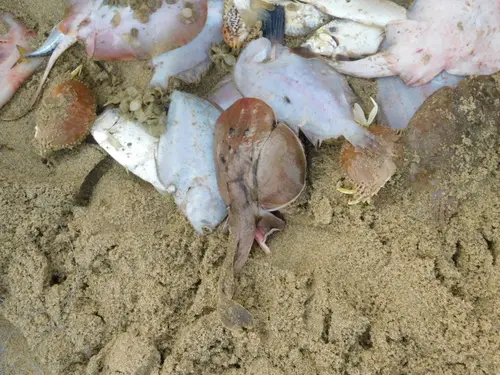
(Figs. 3 D, 13 A, B) Two specimens of a species of Narcine Henle, one each from Point Pedro's Munai (SL- 29) and Kottadi (SL- 57) markets in the Northern Province, were examined. Both have been deposited in the BRT Ichthyology Collection (SL- 29, BRT-I 0010; SL- 57, BRT-I 0015). Both specimens were conspicuous in their possession of a dorsal surface bearing numerous, large (i. e., larger than eye-size) brown, mostly circular to oval spots on a paler brown background. Only two (i. e., Narcine baliensis Carvalho & White and Narcine lingula Richardson) of the 15 species of Narcine recognized by Last et al. (2016 b) exhibit a dorsal surface with similar large brown spots. However, the specimens from Sri Lanka appear to differ morphologically from both species. They differ from N. lingula in bearing a disc that is heart-shaped and widest at a point posterior to, rather than at, the mid-disc, and a caudal fin with a dark, rather than plain, posterior margin. They most closely resemble N. baliensis, known only from eastern Indonesia. However, the disc is heart-shaped rather than broadly oval and, rather than plain, the lower caudal lobe bears brown pigmentation. As a consequence, it seems likely that these specimens represent an undescribed member of the genus, which we have referred to as Narcine sp. 1. The specimens from Sri Lanka differed from one another by 11 bp. The results of the Neighbor-Joining analysis contribute little to help inform the identity of these species because it included data for only three other species of Narcine. Nonetheless, the Sri Lankan specimens differ from their three congeners by 266 – 302 bp. Previous reports of elasmobranchs from Sri Lanka include only Narcine timlei (Bloch & Schneider) (e. g., De Bruin et al. 1994; Morón et al. 1998; De Silva 2006), which bears a dorsal surface without elaborate markings, and Narcine brunnea Annandale (e. g., De Bruin et al. 1994; De Silva 2006), which is now considered a junior synonym of the former spe
