Quay lại danh sách
#36Tập 3

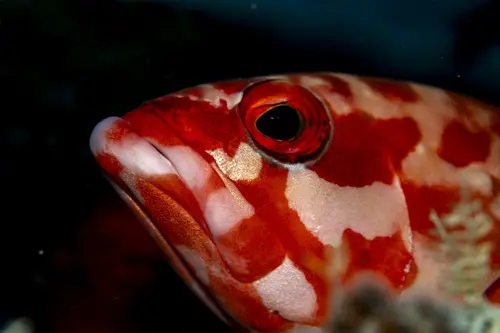
Cá Mú sọc ngang đen

Epinephelus fasciatus (Forskal, 1775)

WoRMS — Tên hợp lệ trên WoRMS
Tên được xác nhận
Xem trên WoRMS (marinespecies.org)

Thông tin chính

Tên gọi khác
Cá Song sọc ngang đen, Cá Song sọc đen
Common Name (EN)
Black-tipped grouper
Kích thước
20 cm. Lớn nhất 30 cm.
Size
20 cm. Maximum 30 cm.

Phân bố

Đông châu Phi, Australia, Ấn Độ, Singapore, Indonesia, Nhật Bản, Philippines, Trung Quốc, Việt Nam. Miền Trung.

Mẫu vật & Tài liệu

Nơi lưu trữ mẫu
Viện Hải dương học (Nha Trang).
Specimen
Institute of Oceanography (Nhatrang).
Tình trạng
Thường gặp.
Status
Common.
Tài liệu dẫn
Weber and de Beaufort, 1931. Herre, 1953. Nguyễn Nhật Thi, 1991.
Literature
Weber and de Beaufort, 1931. Herre, 1953. Nguyen Nhat Thi, 1991.

Sinh học — Sinh thái BIO

Tên tiếng Anh (FishBase)
Blacktip grouper
English name (FishBase)
Blacktip grouper
Chiều dài tối đa
52.0 cm TL
Max length
52.0 cm TL
Trọng lượng tối đa
2,000 g
Max weight
2,000 g
Độ sâu phân bố
4 - 160 m
Depth range
4 - 160 m
Môi trường sống
Estuaries, Coral reefs, Benthic, Rocky
Habitat
Estuaries, Coral reefs, Benthic, Rocky
Sách Đỏ IUCN
LC
IUCN Red List
LC
Nguy hiểm cho người
reports of ciguatera poisoning
Danger to humans
reports of ciguatera poisoning
Kiểu ăn
Săn mồi lớn (ăn thịt)
Feeding type
hunting macrofauna (predator)
Bậc dinh dưỡng
3.72
Trophic level
3.72
Hình thức sinh sản
true hermaphroditism, external fertilization
Reproduction
true hermaphroditism, external fertilization
Giá trị thương mại
Thương mại
Importance
commercial
Nuôi trồng thủy sản
Không/hiếm khi
Aquaculture
never/rarely

Ghi chú chi tiết

Tóm tắt sinh học (FishBase)(Biology summary (FishBase))

Loài này phổ biến ở các sườn ngoài rạn san hô tại độ sâu dưới 15 m, đồng thời cũng xuất hiện ở các vịnh kín và đầm phá với độ sâu từ 4 m trở lên. Loài có thể phân bố ở độ sâu lên đến 160 m. Tại Madagascar, cá hoạt động kiếm ăn cả ngày lẫn đêm với thức ăn chủ yếu là cua thuộc bộ Brachyura, cá, tôm và cua thuộc họ Galatheidae. Ở vùng biển Kenya, thức ăn của chúng bao gồm cua, tôm tít (Stomatopoda), cá, sao biển đuôi rắn (Ophiuroidea) và bạch tuộc. Tại Biển Đỏ, thành phần thức ăn chủ yếu là cá và một số loài giáp xác (chủ yếu là cua). Loài này thường bị đánh bắt bằng câu, lao, bẫy và lưới rê.

Xem văn bản gốc tiếng Anh (FishBase / GBIF)

Common in outer reef slopes at depths below 15 m, also occurs in protected bays and lagoons as shallow as 4 m. May also be found down to a depth of 160 m. At Madagascar it feeds night and day on brachyuran crabs, fishes, shrimps, and galatheid crabs (Ref. 6774). In Kenyan waters it feeds on crabs, stomatopods, fishes, ophiuroids, and octopus (Ref. 6448). In the Red Sea, mostly fishes and some crustaceans (mainly crabs) are consumed (Ref. 6699). Readily caught with hook-and-line, spear, traps, and gill nets (Ref. 39231)..

Ghi chú sinh thái(Ecology notes)

Phổ biến ở các sườn ngoài rạn san hô tại độ sâu dưới 15 m, cũng xuất hiện ở các vịnh kín và đầm phá ở độ sâu nông khoảng 4 m. Loài có thể phân bố ở độ sâu lên đến 160 m. Tại Madagascar, cá kiếm ăn cả ngày lẫn đêm với thức ăn là cua Brachyura, cá, tôm và cua Galatheidae. Ở vùng biển Kenya, thức ăn bao gồm cua, tôm tít, cá, sao biển đuôi rắn và bạch tuộc. Tại Biển Đỏ, thức ăn chủ yếu là cá và một số loài giáp xác (chủ yếu là cua). Phân bố tại các rạn đá và rạn san hô thuộc khu vực Ấn Độ Dương - Thái Bình Dương.

Xem văn bản gốc tiếng Anh (FishBase / GBIF)

Common in outer reef slopes at depths below 15 m, also occurs in protected bays and lagoons as shallow as 4 m. May also be found down to a depth of 160 m. At Madagascar it feeds night and day on brachyuran crabs, fishes, shrimps, and galatheid crabs. In Kenyan waters it feeds on crabs, stomatopods, fishes, ophiuroids, and octopus. In the Red Sea, mostly fishes and some crustaceans (mainly crabs) are consumed (Ref. 5222). In rocky and coral reefs of the Indo-Pacific Region (Ref. 9137).

Ghi chú sinh sản(Reproduction notes)

Loài này thể hiện đặc tính lưỡng tính đồng thời và lưỡng tính tuần tự. Những cá thể nhỏ hơn trong nhóm xã hội là loài lưỡng tính đồng thời, trong khi những cá thể lớn nhất thường mất chức năng sinh sản cái và chỉ sinh sản với vai trò là cá đực.

Xem văn bản gốc tiếng Anh (FishBase / GBIF)

This species exhibits a combination of simultaneous and sequential hermaphroditism. Smaller individuals within a social group are simultaneous hermaphrodites, while the largest often lose female function and reproduce exclusively as a male (Ref. 103751).

Mô tả hình thái (GBIF)(Morphological description (GBIF))

Epinephelus fasciatus: Báez và cộng sự, 2019: bảng phụ (C) (cần xác nhận thêm). Đây là loài ưa ấm phân bố ở khu vực Ấn Độ Dương - Thái Bình Dương, trải dài từ Biển Đỏ đến Port Alfred, Nam Phi ở phía tây, và khắp khu vực phía tây và trung tâm Thái Bình Dương (Craig và cộng sự, 2011; Froese và Pauly, 2020). Đây là loài ngoại lai được ghi nhận một lần duy nhất tại quần đảo Canary, nơi cá thể đầu tiên được ghi nhận dựa trên một cá thể trưởng thành có chiều dài tổng cộng (TL) 30 cm, bắt được vào tháng 6 năm 2018 gần cảng Las Palmas, Gran Canaria (Falcón và cộng sự, 2018).

Xem văn bản gốc tiếng Anh (FishBase / GBIF)

Epinephelus fasciatus: Báez et al., 2019: suppl. tab. (C) (as to be confirmed). An Indo-Pacific warm-affinity species, ranging from the Red Sea to Port Alfred, South Africa in the west, and throughout the western and central Pacific (Craig et al., 2011; Froese and Pauly, 2020). It is a single-record non-native species in the Canaries, from where it has been recently first recorded based on a 30 cm TL adult caught in June 2018 close to the Port of Las Palmas, Gran Canaria (Falcón et al., 2018).

Danh pháp đồng nghĩa & Phân loại gốc

Perca fasciata Forskal, Descript. Animal., p. 11, 1775.
Epinephelus marginalis Bloch, Nat. Ausl. Fische, Vol. 7, p. 14, 1793.
Holocentrus erythraeus Bloch and Schneider, Syst. Ichth., p. 320, 1801.
Holocentrus forskali Lacépède, Hast. Nat. Poiss., Vol. 4, p. 377, 1802.
Holocentrus marginatus Lacépède, Hist. Nat. Poiss. Vol. 4, p. 384, 1802.
Serranus marginalis Cuvier and Valenciennes, Hist. Nat. Poiss., Vol. 2, p. 301, 1828; Gunther, 1859; Meyer, 1885.
Serranus oceanicus Cuvier and Valenciennes, Hist. Nat. Poiss., Vol. 2, p. 302, 1828.
Serranus variolosus Cuvier and Valenciennes, Hist. Nat. Poiss., Vol. 2, p. 354, 1828.
Perca maculata Cuvier and Valenciennes, Hist. Nat. Poiss., Vol. 2, p. 34, 1828.
Serranus tsirimenara Schlegel, Fauna Japonica. Pisces, p. 7, p. 4A, fig. 3 1842.
Epinephelus retouti Bleeker, Verh. Akad. Amsterdam, ser. 2, Vol. 2, p. 339, 1868; Sauvage, 1891.
Serranus fasciatus Klunzinger, Abh. Zool. Bot. Ges. Wien., Vol. 20, p. 681, 1870; Gunther, 1873; Day, 1878; Fowler, 1928; Fowler and Bean, 1930.
Epinephelus fasciatus Bleeker, Verh. Akad. Amsterdam, Vol. 14, Revision Epinephelini p. 119, 1874; Boulenger, 1895; Evermann and Seale, 1907; Fowler, 1918; Weber and de Beaufort, 1931; Herre, 1934.
Serranus cruentatus de Vis, Proc. Linn. Soc. New South Wales, Vol. 8, p. 446, 1906.
Epinephelus tsirimenara Smith and Pope, Proc. U. S. Nat. Mus., Vol. 31, p. 468, 1906; Jordan and Richardson, 1910; Jordan, Tanaka and Snyder, 1913.
Serranus (Epinephelus) fasciatus Zugmayer, Abh. Bayerisch. Akad. Wiss. Math. Phys. Klasse, Vol. 26, p. 10, 1913.