
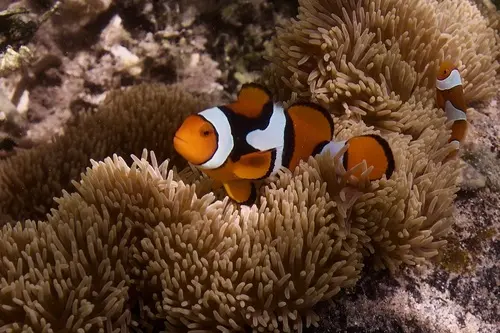
Cá Khoang cổ cam
Amphiprion percula

Thông tin chính
Phân bố
Mẫu vật & Tài liệu
Sinh học — Sinh thái BIO
Ghi chú chi tiết
Cá trưởng thành sinh sống tại các đầm phá và rạn san hô hướng ra biển (Ref. 9710). Mỗi nhóm cá bao gồm một cặp cá sinh sản và từ 0-4 cá thể không sinh sản. Trong mỗi nhóm tồn tại một hệ thống phân cấp dựa trên kích thước: cá cái có kích thước lớn nhất, cá đực lớn thứ hai, và các cá thể không sinh sản có kích thước giảm dần theo thứ bậc. Nếu cá cái chết, cá đực sẽ chuyển đổi giới tính để trở thành cá cái sinh sản, trong khi cá thể không sinh sản lớn nhất sẽ trở thành cá đực sinh sản. Việc duy trì sự khác biệt về kích thước có thể giúp tránh xung đột, vì các cá thể cấp dưới không gây ra mối đe dọa cho các cá thể thống trị (Ref. 47841). Loài đẻ trứng, có tập tính bắt cặp rõ rệt trong mùa sinh sản (Ref. 205). Trứng thuộc loại trứng đáy, bám chặt vào giá thể (Ref. 205). Cá đực có tập tính bảo vệ và quạt nước cho trứng (Ref. 205). Loài này có thể được tìm thấy ở độ sâu nông hơn so với loài <i>A. ocellaris</i>. Chúng cộng sinh với các loài hải quỳ: <i>Heteractis crispa</i>, <i>Heteractis magnifica</i> và <i>Stichodactyla gigantea</i> (Ref. 5911). Loài này đã được nhân giống thành công trong môi trường nuôi nhốt (Ref. 35404, 35413, 35420).
Xem văn bản gốc tiếng Anh (FishBase / GBIF)
Adults inhabit lagoon and seaward reefs (Ref. 9710). Each group of fish consists of a breeding pair and 0-4 non-breeders. Within each group there is a size-based hierarchy: the female is largest, the male is second largest, and the non-breeders get progressively smaller as the hierarchy is descended. If the female dies, the male changes sex and becomes the breeding female, while the largest non-breeder becomes the breeding male. The maintenance of size differences may avoid conflicts, because subordinates do not become a threat to their dominants (Ref. 47841). Oviparous, distinct pairing during breeding (Ref. 205). Eggs are demersal and adhere to the substrate (Ref. 205). Males guard and aerate the eggs (Ref. 205). Maybe found in shallower depths than <i>A. ocellaris</i>. Associated with the anemones: <a href=http://hercules.kgs.ku.edu/hexacoral/anemone2/speciesdetail.cfm?genus=Heteractis&subgenus=&species=crispa&subspecies=&synseniorid=89&validspecies=Heteractis%20crispa&authorship=%28Hemprich%20and%20Ehrenberg%20in%20Ehrenberg%2C%201834%29><i>Heteractis crispa</i></a>, <a href=http://hercules.kgs.ku.edu/hexacoral/anemone2/speciesdetail.cfm?genus=Heteractis&subgenus=&species=magnifica&subspecies=&synseniorid=83&validspecies=Heteractis%20magnifica&authorship=%28Quoy%20and%20Gaimard%2C%201833%29><i>Heteractis magnifica</i></a>, and <a href=http://hercules.kgs.ku.edu/hexacoral/anemone2/speciesdetail.cfm?genus=Stichodactyla&subgenus=&species=gigantea&subspecies=&synseniorid=147&validspecies=Stichodactyla%20gigantea&authorship=%28Forsk%E5l%2C%201775%29><i>Stichodactyla gigantea</i></a> (Ref. 5911). This species has been reared in captivity (Ref. 35404, 35413, 35420).
Phân bố ở vùng ven bờ (Ref. 75154). Cá trưởng thành sinh sống tại các đầm phá và rạn san hô hướng ra biển (Ref. 9710). Là loài ăn tạp. Hoạt động chủ yếu vào ban ngày (Ref. 113699).
Xem văn bản gốc tiếng Anh (FishBase / GBIF)
Occurs inshore (Ref. 75154). Adults inhabit lagoon and seaward reefs (Ref. 9710). Omnivore. Diurnal species (Ref. 113699).
Mỗi nhóm cá bao gồm một cặp cá sinh sản và từ 0-4 cá thể không sinh sản. Trong mỗi nhóm tồn tại một hệ thống phân cấp dựa trên kích thước: cá cái có kích thước lớn nhất, cá đực lớn thứ hai, và các cá thể không sinh sản có kích thước giảm dần theo thứ bậc. Nếu cá cái chết, cá đực sẽ chuyển đổi giới tính để trở thành cá cái sinh sản, trong khi cá thể không sinh sản lớn nhất sẽ trở thành cá đực sinh sản (Ref. 47841). Loài đẻ trứng, có tập tính bắt cặp rõ rệt trong mùa sinh sản (Ref. 205). Trứng thuộc loại trứng đáy, bám chặt vào giá thể (Ref. 205). Cá đực có tập tính bảo vệ và quạt nước cho trứng (Ref. 205). Xem thêm Ref. 7471.
Xem văn bản gốc tiếng Anh (FishBase / GBIF)
Each group of fish consists of a breeding pair and 0-4 non-breeders. Within each group there is a size-based hierarchy: the female is largest, the male is second largest, and the non-breeders get progressively smaller as the hierarchy is desceded. If the female dies, the male changes sex and becomes the breeding female, while the largest non-breeder becomes the breeding male (Ref. 47841). Oviparous, distinct pairing during breeding (Ref. 205). Eggs are demersal and adhere to the substrate (Ref. 205). Males guard and aerate the eggs (Ref. 205). Also Ref. 7471.
