
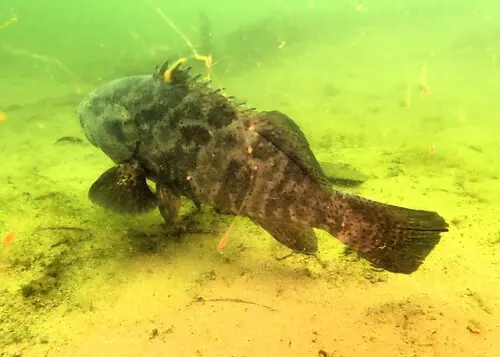
Cá Mú chấm nâu đen
Epinephelus nigropunctatus
Thông tin chính
Phân bố
Mẫu vật & Tài liệu
Sinh học — Sinh thái BIO
Ghi chú chi tiết
Diagnosis: Body elongate, robust (subcylindrical), oblong or deep and compressed; body depth greater than, subequal to or less than head length and contained 2.3 - 3.7 times in SL, the body width 1.8 - 2.8 in the depth; head length 2.1 - 2.8 in SL; preorbital depth 6.7 - 15 times in head length; preopercle rounded or angular, the posterior edge serrate, with the serrae at the angle more or less enlarged; a few species with small serrae (mostly covered by skin) on the ventral edge. Dorsal fin usually with 11 spines (10 spines in E. analogus, exsul and nigritus, 9 in E. acanthistius) and 12 - 19 rays; length of base of soft-rayed part of dorsal fin not more than base of spinous part. Anal fin with 3 distinct spines and 7 - 10 (very rarely 7 or 10) rays. Caudal fin rounded, truncate or concave, with 8 + 7 branched rays and 8 - 10 + 7 - 10 procurrent rays. Pectoral fin rounded, with the middle rays longest. Scales on body ctenoid or smooth. Canines present at front of jaws, but they may be small in some species; no distinctly enlarged canine tooth at midside of lower jaw; teeth present on palatines; maxilla of adults without a distinct bony knob on ventroposterior corner, but there may be an abrupt step or hook-like process (covered by the upper lip) on the distal part of the ventral edge; supramaxilla well developed. Supraneural bones 2; dorsal and anal fins without trisegmental pterygiophores; rear edge of first dorsal pterygiophore with or without excavation for tip of 2 nd neural spine; epipleural ribs on first 8 - 10 vertebrae. The diversity of cranial morphology of the many species assigned to Epinephelus makes it difficult to recognize diagnostic cranial characters for the genus.
