
Cá Mú cỏ
Epinephelus nebulosus

Thông tin chính
Phân bố
Mẫu vật & Tài liệu
Sinh học — Sinh thái BIO
Ghi chú chi tiết
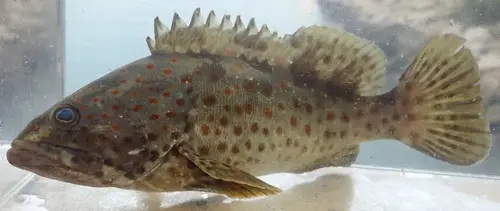
Diagnosis: Dorsal fin XL, 14 - 16; anal fin III, 8; pectoral fin rays 18 - 20; lateral-line scales 58 - 65; lateral scale series 100 - 118; gill-rakers 8 - 10 + 14 - 17, total 23 - 26 (including 3 - 8 rudiments on each limb. Body elongate, the depth contained 2.9 - 3.7 times in SL (for fish 10 - 78 SL); body width 1.4 - 2.0 times in the depth; head length 2.3 - 2.6 times in SL; pectoral fins 1.6 - 2.2 times and pelvic fins 1.9 - 2.7 times in head length. Caudal fin rounded; dorsal fin with 3 rd or 4 th spines longest, 2.9 - 4.0 times in head length, the interspinous membranes distinctly incised; anal fin with 3 rd spine usually longer than the 2 nd; the fin margin rounded; pectoral fins fleshy. Interorbital flat or slightly convex; preopercle subangular, the posterior edge with enlarged serrae at the angle and a broad shallow notch just above the angle; upper edge of operculum straight or somewhat convex. Maxilla reaches to or slightly past a vertical at rear edge of eye; midlateral part of lower jaw with 2 or 3 rows of subequal teeth. Nostrils subequal. Lateral body scales ctenoid, with minute auxiliary scales; lateral-line tubes of anterior scales branched in adults; adults with small bony platelets on lateral side of 1 st gill arch. Pyloric caeca numerous (about 50 - 60). Colour: Head and body tan dorsally, shading to whitish ventrally; numerous small brownish orange or reddish brown spots on head, body and median fins; body with 5 faint, irregular, oblique, dark bars which bifurcate ventrally; first dark bar below anterior dorsal fin spines, last bar on caudal peduncle; 2 dark spots on interopercle and another 1 or 2 at junction of sub- and interopercles. Orange spots turn brown on exposure to air and become fainter (more diffuse) in preservative.
