Quay lại danh sách
#282Tập 4

Cá Một Sừng mõm dài

Naso unicornis (Forskal, 1775)

WoRMS — Tên hợp lệ trên WoRMS
Tên được xác nhận
Xem trên WoRMS (marinespecies.org)

Thông tin chính

Tên gọi khác
Cá Bắp một sừng mõm dài, Cá Sừng biển mõm dài
Common Name (EN)
Long-snouted unicorn-fish.
Kích thước
200 - 250mm, lớn nhất: 593mm.
Size
200 - 250mm, Maximum: 593mm.

Phân bố

Hồng Hải, Srilanca, Australia, Melanesia, Polynesia, Hawai, Nhật Bản, Trung Quốc, Philippin, Indonesia, Việt Nam. Vịnh Bắc Bộ, Trung Bộ, Nam Bộ.

Mẫu vật & Tài liệu

Nơi lưu trữ mẫu
Viện Hải Dương Học (Nha Trang).
Specimen
Institute of Oceanography (Nhatrang).
Tình trạng
Thường gặp.
Status
Common.
Tài liệu dẫn
Fowler and Bean, 1929. de Beaufort, 1951. Herre, 1953. Shih-Chied Shen and Peng-Chee Lim, 1973. Orsi, 1974
Literature
Fowler and Bean, 1929. de Beaufort, 1951. Herre, 1953. Shih-Chied Shen and Peng-Chee Lim, 1973. Orsi, 1974

Sinh học — Sinh thái BIO

Tên tiếng Anh (FishBase)
Bluespine unicornfish
English name (FishBase)
Bluespine unicornfish
Chiều dài tối đa
70.0 cm FL
Max length
70.0 cm FL
Tuổi thọ
54.5 năm
Longevity
54.5 năm
Độ sâu phân bố
0 - 180 m
Depth range
0 - 180 m
Môi trường sống
Coral reefs, Rocky
Habitat
Coral reefs, Rocky
Nguy hiểm cho người
reports of ciguatera poisoning
Danger to humans
reports of ciguatera poisoning
Kiểu ăn
Kiếm ăn trên nền đáy
Feeding type
browsing on substrate
Hình thức sinh sản
Phân giới tính, thụ tinh ngoài
Reproduction
dioecism, external fertilization
Giá trị thương mại
Thương mại
Importance
commercial
Nuôi trồng thủy sản
Không/hiếm khi
Aquaculture
never/rarely

Ghi chú chi tiết

Tóm tắt sinh học (FishBase)(Biology summary (FishBase))

Cá trưởng thành sinh sống tại các kênh rạch, vùng nước nông, đầm phá và các rạn san hô hướng biển nơi có dòng chảy mạnh (Ref. 48637). Loài thuộc nhóm cá tầng trung - đáy (Ref. 58302). Thường xuất hiện theo nhóm nhỏ, đôi khi sống đơn độc (Ref. 90102). Cá con thường phân bố ở các vịnh nông kín gió và khu vực cảng (Ref. 48637). Hoạt động chủ yếu vào ban ngày, thức ăn chính là các loài tảo nâu lá lớn như Sargassum. Đã ghi nhận tập tính đẻ trứng theo cặp. Độ sâu tối thiểu được ghi nhận theo Ref. 128797.

Xem văn bản gốc tiếng Anh (FishBase / GBIF)

Adults inhabit channels, moats, lagoon and seaward reefs with strong surge (Ref. 48637). Benthopelagic (Ref. 58302). Typically occurring in small groups. Sometimes solitary (Ref. 90102). Juveniles in shallow protected bays and harbours (Ref. 48637). Mainly diurnal, feed on coarse leafy brown algae like <i>Sargassum</i>. Pair-spawning has been observed. Minimum depth reported taken from Ref. 128797.

Ghi chú sinh thái(Ecology notes)

Sinh sống tại các kênh rạch, vùng nước nông, đầm phá và các rạn san hô hướng biển có dòng chảy mạnh. Thường xuất hiện theo nhóm nhỏ. Cá con phân bố tại các vịnh nông kín gió và khu vực cảng (Ref. 48637). Hoạt động chủ yếu vào ban ngày. Thức ăn bao gồm các loài tảo nâu lá lớn như Sargassum. Những cá thể trưởng thành có kích thước lớn đôi khi sống đơn độc ở rìa rạn san hô (Ref. 3921).

Xem văn bản gốc tiếng Anh (FishBase / GBIF)

Inhabits channels, moats, lagoon and seaward reefs with strong surge. Typically occurring in small groups. Juveniles in shallow protected bays and harbours (Ref. 48637). Mainly diurnal. Feeds on coarse leafy brown algae like <i>Sargassum</i>. Large adults sometimes solitary at edge of reef (Ref. 3921).

Ghi chú sinh sản(Reproduction notes)

Đẻ trứng theo cặp (Ref. 240).

Xem văn bản gốc tiếng Anh (FishBase / GBIF)

Spawn in pairs (Ref. 240).

Mô tả hình thái (GBIF)(Morphological description (GBIF))

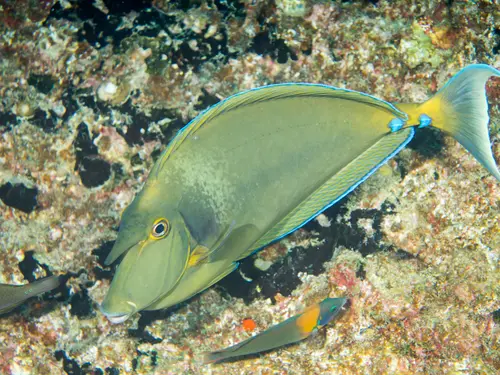
Đặc điểm nhận dạng: Cơ thể màu xám lục với một chiếc sừng xương đặc trưng ở phía trước mắt. Hai bên cuống đuôi có hai tấm vảy màu xanh lam với các gai sắc nhọn như lưỡi dao. Mép vây lưng và vây bụng có màu trắng ở cá con và chuyển sang màu xanh huỳnh quang ở cá trưởng thành. Vây đuôi thay đổi từ dạng khuyết với mép ngoài màu trắng ở cá non sang dạng cụt với các thùy kéo dài thành sợi ở cá trưởng thành.

Xem văn bản gốc tiếng Anh (FishBase / GBIF)

Diagnosis: Greenish-grey body with a unique bony horn in front of the eyes. Two blue plates with knife-like spines on either side of the caudal peduncle. The dorsal and ventral fin margins are white in juveniles and bluish fluorescent in adults. The caudal fin transitions from emarginate with a white distal margin in young individuals to a truncated shape with filamentous lobes in adults.

Danh pháp đồng nghĩa & Phân loại gốc

Naseus fronticornis Cuvier and Valenciennes, Hist. Nat. Poissons, Vol. 10, p. 191 (259), 1835; Cuvier, 1836; Schlegel, 1842; Bleeker, 1856.
Chaetodon unicornis Forskal, Descr. Animal, p. 63, 1775.
Aspisurus unicornis Ruppell, Atlas Reise Nordl Afrika, Fische, Rothen Meeres, p. 60, 1828.
Naseus unicornis Gunther, Cat. Fish. Brit. Mus., Vol. 3, p. 348, 1861; Alleyne and Macleay, 1876; Pellegrin, 1907.
Acanthurus unicornis Shaw, General Zoology, Vol. 4, p. 374, pl. 50, 1803; Jordan and Fowler, 1902; Jordan and Evermann, 1905; Evermann and Seale, 1907.
Monoceros unicornis Snyder, Proc. U. S. Nat. Mus., Vol. 42, p. 510, 1912.
Naso unicornis Fowler, Copeia, No. 58, June 18, p. 64, 1918; Herre, 1927; Fowler, 1928; Fowler and Bean, 1929.
Monoceros biaculeatus Bloch and Schneider, Syst. Ichth. Bloch, p. 180, 1801.
Naso fronticornis Lacépède, Hist. Nat. Pois., Vol. 3, pp. 104, 105, pl. 7. fig.2, 1802.
Keris anginosus Cuvier and Valenciennes, Hist. Nat. Poiss., Vol. 10, p. 304, pl. 295, 1835.
Priodon anginosus Bleeker, Nat. Tijds. Nederland. Indie, Vol. 6, p. (457) 492, 1854.
Naseus olivaceous Cuvier and Valenciennes, Hist. Nat. Poiss., Vol. 10, p. 288, 1835.
Naseus anginosus Bleeker, Acta Soc. Sci. Indo - Neerl., Vol. 8, 1860.
Harpurus monoceros (Forster) Lichtenstein, Descript. Animal, p. 219, 1844.
Priodon amboinensis Bleeker, Nat. Tijds. Nederland. Indie, Vol. 4, p. 93, 1853.
Priodon anginosus Bleeker, Nat. Tijds. Ned. Ind., Vol. 6, p. 492, 1854.
Naseus punikar Thiollière, Fauna Woodlark, p. 182, 1857.