Quay lại danh sách
#184Tập 5

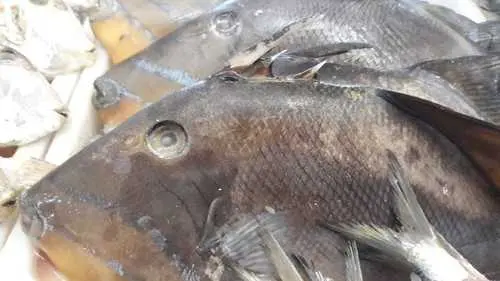
Cá Bò Hoàng Hậu

Balistes vetula Linnaeus, 1758

WoRMS — Tên hợp lệ trên WoRMS
Tên được xác nhận
Xem trên WoRMS (marinespecies.org)

Thông tin chính

Tên gọi khác
Cá Bò da Hoàng Hậu, Cá Bò gai Hoàng Hậu
Common Name (EN)
Queen triggerfish
Kích thước
Lớn nhất 60 cm.
Size
Maximum 60 cm.

Mô tả hình thái

Found over rocky or coral areas (Ref. 5217). May form schools, sometimes solitary over sand and grassy areas. Feeds mainly on benthic invertebrates (Ref. 4727). It preys on sea urchins by blowing water to overturn it and then attacks it where the spines are short (Ref. 9710). Excellent food fish but occasionally can cause intoxication due to the liver.EN · FishBase/GBIF

Sinh thái & Dinh dưỡng

Habitat: Neritic, Estuaries, Coral reefs, Soft bottom. Feeding: hunting macrofauna (predator). Depth range: 2 - 275 m. Found in coral reef environments, near the bottom, from shallow sandy or grassy areas to the upper slope of the reef. Employs different feeding behaviours to capture and manipulate different type of prey, for example, it uses suction feeding to capture worms and other soft prey, while it feeds on crabs and sea urchins by directly biting off parts of the prey (Ref. 45549). Sessile invertebrate feeder (Ref. 57616).EN · FishBase/GBIF

Phân bố

Đại Tây Dương, Vịnh Mêhicô, Đông Châu Phi, Ấn Độ, Inđônêxia, Trung Quốc. Miền Trung Việt Nam.

Giá trị kinh tế

Commercial importance: minor commercial. Price category: medium. Aquaculture: never/rarely. Vulnerability index: 53.73/100EN · FishBase/GBIF

Mẫu vật & Tài liệu

Nơi lưu trữ mẫu
Viện Nghiên Cứu Hải Sản (Hải Phòng)
Specimen
Haiphong Branch of Institute of Oceanography.
Tình trạng
Rất hiếm.
Status
Very rare.
Tài liệu dẫn
De Beaufort and Briggs, 1962. Carcasson, 1977. Wang C.X., 1993.
Literature
De Beaufort and Briggs, 1962. Carcasson, 1977. Wang C.X., 1993.

Sinh học — Sinh thái BIO

Tên tiếng Anh (FishBase)
Queen triggerfish
English name (FishBase)
Queen triggerfish
Chiều dài tối đa
60.0 cm TL
Max length
60.0 cm TL
Trọng lượng tối đa
5,440 g
Max weight
5,440 g
Tuổi thọ
23.0 năm
Longevity
23.0 năm
Độ sâu phân bố
2 - 275 m
Depth range
2 - 275 m
Môi trường sống
Neritic, Estuaries, Coral reefs, Soft bottom
Habitat
Neritic, Estuaries, Coral reefs, Soft bottom
Nguy hiểm cho người
Độc khi ăn
Danger to humans
poisonous to eat
Kiểu ăn
Săn mồi lớn (ăn thịt)
Feeding type
hunting macrofauna (predator)
Bậc dinh dưỡng
3.82
Trophic level
3.82
Hình thức sinh sản
Phân giới tính, thụ tinh ngoài
Reproduction
dioecism, external fertilization
Mùa sinh sản
No obvious seasonal peak
Spawning
No obvious seasonal peak
Giá trị thương mại
Thương mại nhỏ
Importance
minor commercial
Nuôi trồng thủy sản
Không/hiếm khi
Aquaculture
never/rarely

Ghi chú chi tiết

Tóm tắt sinh học (FishBase)(Biology summary (FishBase))

Phân bố ở các vùng đáy đá hoặc rạn san hô (Ref. 5217). Có thể tập trung thành đàn, đôi khi sống đơn độc trên các bãi cát và thảm cỏ biển. Thức ăn chủ yếu gồm các loài động vật không xương sống ở tầng đáy (Ref. 4727). Loài này săn mồi bằng cách phun nước để lật ngửa cầu gai (nhím biển), sau đó tấn công vào phần gai ngắn của chúng (Ref. 9710). Là loài cá thực phẩm có chất lượng tuyệt hảo nhưng thỉnh thoảng có thể gây ngộ độc do gan.

Xem văn bản gốc tiếng Anh (FishBase / GBIF)

Found over rocky or coral areas (Ref. 5217). May form schools, sometimes solitary over sand and grassy areas. Feeds mainly on benthic invertebrates (Ref. 4727). It preys on sea urchins by blowing water to overturn it and then attacks it where the spines are short (Ref. 9710). Excellent food fish but occasionally can cause intoxication due to the liver.

Ghi chú sinh thái(Ecology notes)

Sinh sống trong môi trường rạn san hô, gần đáy, từ các vùng cát nông hoặc thảm cỏ biển cho đến phần trên của sườn rạn. Loài này sử dụng các tập tính kiếm ăn khác nhau để bắt và xử lý các loại con mồi khác nhau; ví dụ, chúng dùng cơ chế hút để bắt giun và các con mồi mềm khác, trong khi ăn cua và cầu gai bằng cách cắn trực tiếp vào các bộ phận của con mồi (Ref. 45549). Chuyên ăn các loài động vật không xương sống bám đáy (Ref. 57616).

Xem văn bản gốc tiếng Anh (FishBase / GBIF)

Found in coral reef environments, near the bottom, from shallow sandy or grassy areas to the upper slope of the reef. Employs different feeding behaviours to capture and manipulate different type of prey, for example, it uses suction feeding to capture worms and other soft prey, while it feeds on crabs and sea urchins by directly biting off parts of the prey (Ref. 45549). Sessile invertebrate feeder (Ref. 57616).

Danh pháp đồng nghĩa & Phân loại gốc

Balistes vetula Linnaeus, Syst. Nat. ed.10, Vol.1, p.327, 1758. Bloch, 1786. Lesson, 1830. Hollard, 1854. Gunther, 1870. Day, 1878. Smith, 1950.
Balistes bellus Walbaum, Ichthyologiae, pars III, pt 3: 1 - 723, 1792.
Balistes equestris Gronow, Syst. Ed. Gray, p. 27, 1854.
Balistes vetula trinitatis Nichols and Murphy, Long island fauna, Brooklyn Mus. Sci. Bull., 1914.