
Quay lại danh sách
#23Tập 5

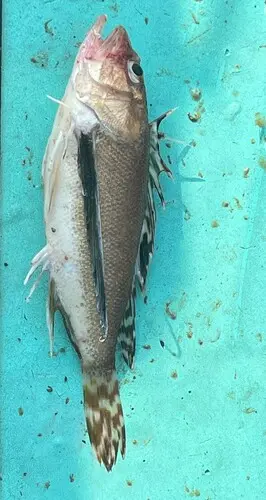
Loài cá Mù Làn Vây Chấm

Apistus carinatus (Bloch and Schneider, 1801)

WoRMS — Tên hợp lệ trên WoRMS
Tên được xác nhận · cập nhật WoRMS: 2026-09-02
Xem trên WoRMS (marinespecies.org)

Thông tin chính

Tên gọi khác
Cá Mù Làn Vây Chấm, Cá Bọ cạp biển Vây Chấm
Common Name (EN)
Ocellated waspfish
Kích thước
Lớn nhất 180mm.
Size
Maximum 180mm.

Mô tả hình thái

Inhabits soft bottoms of the continental shelf. Primarily known from trawls over prawn-grounds but divers looking in suitable habitats can come across them, especially at night. During the day it buries itself deep in the sand with just the eyes exposed. When disturbed, it spreads its long pectoral fins with the bright upper color to deter predators. It uses its fins to corner prey and has sensitive barbels below the mouth to detect those buried in the substrate (Ref. 48635). Fin spines venomous (anterolateral glandular groove with venom gland (Ref. 57406)) (Ref. 30573). Sold in small quantities either fresh or dried and salted in markets. Minimum depth reported taken from Ref. 57178.EN · FishBase/GBIF

Sinh thái & Dinh dưỡng

Habitat: Coral reefs, Benthic, Soft bottom. Depth range: 14 - 60 m. Inhabits soft bottoms of the continental shelf. Primarily known from trawls over prawn-grounds but divers looking in suitable habitats can come across them, especially at night. During the day it buries itself deep in the sand with just the eyes exposed. When disturbed, it spreads its long pectoral fins with the bright upper color to deter predators. It uses its fins to corner prey and has sensitive barbels below the mouth to detect those buried in the substrate (Ref. 48635). Fin spines venomous (anterolateral glandular groove with venom gland (Ref. 57406)) (Ref. 30573).EN · FishBase/GBIF

Phân bố

Biển Đỏ, Vịnh Pơxian, Ôttrâylia, Ấn Độ, Philíppin, Trung Quốc, Đài Loan, Nhật Bản. Miền Trung Việt Nam.

Giá trị kinh tế

Commercial importance: minor commercial. Price category: unknown. Aquaculture: never/rarely. Vulnerability index: 10.0/100EN · FishBase/GBIF

Mẫu vật & Tài liệu

Nơi lưu trữ mẫu
Viện Hải Dương Học (Nha Trang).
Specimen
Institute of Oceanography (Nha Trang).
Tình trạng
Ít gặp.
Status
Uncommon.
Tài liệu dẫn
Herre, 1953. Matsubara, 1955. Chu Nguyên Đinh, 1962. De Beaufort and Briggs, 1962. Orsi, 1974.
Literature
Herre, 1953. Matsubara, 1955. Chu, 1962. De Beaufort and Briggs, 1962. Orsi, 1974.

Sinh học — Sinh thái BIO

Tên tiếng Anh (FishBase)
Ocellated waspfish
English name (FishBase)
Ocellated waspfish
Chiều dài tối đa
20.0 cm TL
Max length
20.0 cm TL
Độ sâu phân bố
14 - 60 m
Depth range
14 - 60 m
Môi trường sống
Coral reefs, Benthic, Soft bottom
Habitat
Coral reefs, Benthic, Soft bottom
Nguy hiểm cho người
Có nọc độc
Danger to humans
venomous
Giá trị thương mại
Thương mại nhỏ
Importance
minor commercial
Nuôi trồng thủy sản
Không/hiếm khi
Aquaculture
never/rarely

Ghi chú chi tiết

Tóm tắt sinh học (FishBase)(Biology summary (FishBase))

Sinh sống ở vùng đáy mềm của thềm lục địa. Chủ yếu được ghi nhận từ hoạt động đánh bắt bằng lưới kéo ở các ngư trường khai thác tôm, tuy nhiên các thợ lặn tìm kiếm ở các sinh cảnh phù hợp vẫn có thể bắt gặp chúng, đặc biệt là vào ban đêm. Ban ngày, loài này vùi mình sâu vào lớp cát và chỉ để lộ phần mắt. Khi bị quấy rầy, chúng xòe rộng các vây ngực dài với màu sắc sáng ở mặt trên nhằm xua đuổi kẻ săn mồi. Chúng sử dụng các vây để dồn con mồi vào góc và có các râu nhạy cảm dưới miệng để phát hiện con mồi vùi mình trong chất đáy (Ref. 48635). Các gai vây có độc (có rãnh tuyến trước bên chứa tuyến nọc độc (Ref. 57406)) (Ref. 30573). Được bày bán với số lượng ít ở các chợ dưới dạng tươi sống hoặc phơi khô ướp muối. Độ sâu tối thiểu ghi nhận được lấy từ Ref. 57178.

Xem văn bản gốc tiếng Anh (FishBase / GBIF)

Inhabits soft bottoms of the continental shelf. Primarily known from trawls over prawn-grounds but divers looking in suitable habitats can come across them, especially at night. During the day it buries itself deep in the sand with just the eyes exposed. When disturbed, it spreads its long pectoral fins with the bright upper color to deter predators. It uses its fins to corner prey and has sensitive barbels below the mouth to detect those buried in the substrate (Ref. 48635). Fin spines venomous (anterolateral glandular groove with venom gland (Ref. 57406)) (Ref. 30573). Sold in small quantities either fresh or dried and salted in markets. Minimum depth reported taken from Ref. 57178.

Ghi chú sinh thái(Ecology notes)

Sinh sống ở vùng đáy mềm của thềm lục địa. Chủ yếu được ghi nhận từ hoạt động đánh bắt bằng lưới kéo ở các ngư trường khai thác tôm, tuy nhiên các thợ lặn tìm kiếm ở các sinh cảnh phù hợp vẫn có thể bắt gặp chúng, đặc biệt là vào ban đêm. Ban ngày, loài này vùi mình sâu vào lớp cát và chỉ để lộ phần mắt. Khi bị quấy rầy, chúng xòe rộng các vây ngực dài với màu sắc sáng ở mặt trên nhằm xua đuổi kẻ săn mồi. Chúng sử dụng các vây để dồn con mồi vào góc và có các râu nhạy cảm dưới miệng để phát hiện con mồi vùi mình trong chất đáy (Ref. 48635). Các gai vây có độc (có rãnh tuyến trước bên chứa tuyến nọc độc (Ref. 57406)) (Ref. 30573).

Xem văn bản gốc tiếng Anh (FishBase / GBIF)

Inhabits soft bottoms of the continental shelf. Primarily known from trawls over prawn-grounds but divers looking in suitable habitats can come across them, especially at night. During the day it buries itself deep in the sand with just the eyes exposed. When disturbed, it spreads its long pectoral fins with the bright upper color to deter predators. It uses its fins to corner prey and has sensitive barbels below the mouth to detect those buried in the substrate (Ref. 48635). Fin spines venomous (anterolateral glandular groove with venom gland (Ref. 57406)) (Ref. 30573).

Danh pháp đồng nghĩa & Phân loại gốc

Scorpaena carinata Bloch and Schneider, Syst. Ichth., p.193, 1801. Day, 1875. McCulloch, 1915.
Apistus balnearum Ogilby, 1910.
Apistus faurei Gilchrist and Thompson, 1908.
Apistus alatus Cuvier and Valenciennes, Hist. Nat. Poiss., Vol.4, p.392, 1929. Temminck and Schlegel, 1843. Gunther, 1860. Bleeker, 1878. Herre, 1953. Chu, 1962.
Apistus venerans Jordan and Starks, Proc. U.S. Nat. Mus., Vol.27, p.148, 1913.
Apistus evolans Jordan and Starks, Proc. U.S. Nat. Mus., Vol.27, p.146, 1913.