
Quay lại danh sách
#129Tập 4

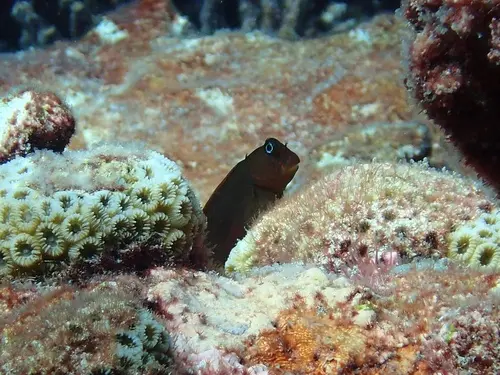
Cá Mào Gà nâu

Cirripectus variolosus (Cuvier and Valenciennes, 1836)

WoRMS — Tên cũ — đã được cập nhật
Tên hiện hành: Cirripectes variolosus
Xem trên WoRMS (marinespecies.org)

Thông tin chính

Tên gọi khác
Cá Mào rạn Gà nâu, Cá Mào gà biển Gà nâu
Common Name (EN)
Red speckled blenny
Kích thước
80 mm.
Size
80 mm.

Phân bố

Ấn Độ, Hồng Hải, Hawai, Australia, Indonesia, Nhật Bản, Philippin, Việt Nam. Trung Bộ.

Mẫu vật & Tài liệu

Nơi lưu trữ mẫu
Viện Hải Dương Học (Nha Trang).
Specimen
Institute of Oceanography (Nhatrang).
Tình trạng
Rất hiếm.
Status
Very rare
Tài liệu dẫn
de Beaufort, 1940. Herre 1953. Orsi, 1974.
Literature
de Beaufort, 1940. Herre , 1953. Orsi, 1974.

Sinh học — Sinh thái BIO

Sách Đỏ IUCN
LC
IUCN Red List
LC

Ghi chú chi tiết

Morphological description (GBIF)(Mô tả hình thái (GBIF))

Description. Dorsal-fin rays XI, 14; anal-fin rays II, 14; pectoral-fin rays 16; pelvic-fin rays I, 4; segment caudal-fin rays 6 + 5 (branched 4 + 4); vertebrae 9 + 18; nuchal cirri 17 (both side); supraorbital cirri 5 (both side); nasal cirri 4 (5 in right side); lateral line tubes 16 (both side). Morphometric data are presented in Table 1. The body is slightly elongate, moderately compressed posteriorly, and deepest at the base of the pectoral fin. The snout is slightly elevated, and except for a slight protrusion at the base of the nasal cirri, the dorsal profile from the anterior margin of the eye to the snout is nearly vertical. Posteriorly, the profile rises gently toward the nape, then gradually descends to the caudal peduncle. The ventral profile is slightly convex from the lower jaw tip to the pelvic-fin origin, becomes gently convex again at the abdominal region, and thereafter remains nearly straight and parallel to the body axis toward the anus, rising slightly along the anal-fin base and remaining nearly straight before reaching the caudal peduncle. The anus is located slightly anterior to mid-body. The head is bluntly rounded and widest at the mid-cheek region. The eye is moderately sized and positioned anterodorsally on the head. The nuchal cirri are arranged in two separated clusters at the middle of the nape. A complex cephalic sensory pore system is present. The posterior portion of the dorsal-fin rays is separated from the fin base, and the posteriormost membrane does not attach to the caudal peduncle. The anal-fin base extends from a point directly below the 10 th dorsal-fin spine to the vertical below the posterior end of the dorsal-fin base, and the posteriormost anal-fin ray is split from its base. The caudal fin is arcuate. The pectoral-fin origin lies below the first to second dorsal-fin spines, with the ventralmost pectoral-fin base aligned below the second dorsal-fin spine; the longest ray reaches the level of the anus, and the posterior m

Xem bản dịch tiếng Việt (tham khảo)

Danh pháp đồng nghĩa & Phân loại gốc

Salarias variolosus Cuvier and Valenciennes, Hist. Nat. Poiss., Vol. 11, p. 317, pl. 330, 1836; Gunther, 1861; Ogilby, 1889; Fowler, 1900; Herre, 1953; Matsubara, 1955.
Salarias castaneus Cuvier and Valenciennes, Hist. Nat. Poissons, Vol. 11, p. 324, 1836; Bleeker, 1879; Sauvage, 1891.
Salarias filamentosus Alleyne and Macleay, Proc. Lin. Soc. New South Wales, Vol. 1, No. 4, p. 337, pl. 14, fig. 1, 1877.
Salarias alboapicalis Waite, Records Australian Mus., Vol. 31, p. 224, 1909.
Salarias nigripes Seale, Occas Papers Bishop Mus., Vol. 1, p. 127, 1901.
Cirripectes variolosus McCulloch and McNeil, Records Australian Mus., Vol. 12, p. 22, 1918; Fowler, 1928; Herre, 1939; Schultz, 1941.
Alticus variolosus Jordan and Evermann, Bull. U. S. Fish. Comm., Vol. 23, p. 497, 1903; Jordan and Seale, 1905; Kendall and Radcliffe, 1912.
Rupiscartes variolosus Fowler and Ball, Bull. Bishop Mus., Vol. 26, p. 29, 1925.
Exallias obscurus Borodin, Amer. Mus. Nat. Hist. Novitates, No. 281, p. 1, 1927.
Cirripectus filamentosus McCulloch, Mem. 5, Australian Mus., Check list Fishes Australia, Part 3, p. 345, 1929.
Ophilioblennius vanderbilti Fowler, Akad. Nat. Sci. Phila., Monograph 2, p. 242, 1938.