
Quay lại danh sách
#138Tập 4

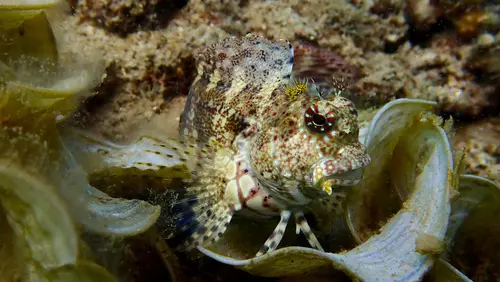
Cá Mào Gà vện

Salarias fasciatus (Bloch, 1786)

WoRMS — Tên hợp lệ trên WoRMS
Tên được xác nhận
Xem trên WoRMS (marinespecies.org)

Thông tin chính

Tên gọi khác
Cá Mào rạn Gà vện, Cá Mào gà biển Gà vện
Common Name (EN)
Lineated Blenny, Banded Blenny.
Kích thước
70 - 100mm. Lớn nhất: 120mm.
Size
70 - 100mm. Maximum: 120mm.

Phân bố

Hồng Hải, Australia, Indonesia, Philippin, Đài Loan, Nhật Bản, Fiji, Micronesia, Việt Nam. Vịnh Bắc Bộ đến Trung Bộ.

Mẫu vật & Tài liệu

Nơi lưu trữ mẫu
Viện Hải Dương Học (Nha Trang).
Specimen
Institute of Oceanography (Nhatrang).
Tình trạng
Ít, thường gặp.
Status
Seldom abundant, common.
Tài liệu dẫn
Herre, 1953. Chu Nguyên Đỉnh, 1962. Orsi, 1974. Myers, 1991.
Literature
Herre, 1953. Chu, 1962. Orsi, 1974. Myers, 1991.

Sinh học — Sinh thái BIO

Tên tiếng Anh (FishBase)
Jewelled blenny
English name (FishBase)
Jewelled blenny
Chiều dài tối đa
14.0 cm TL
Max length
14.0 cm TL
Độ sâu phân bố
0 - 8 m
Depth range
0 - 8 m
Môi trường sống
Neritic, Estuaries, Coral reefs, Soft bottom, Rubble
Habitat
Neritic, Estuaries, Coral reefs, Soft bottom, Rubble
Sách Đỏ IUCN
LC
IUCN Red List
LC
Nguy hiểm cho người
Vô hại
Danger to humans
harmless
Kiểu ăn
grazing on aquatic plants
Feeding type
grazing on aquatic plants
Bậc dinh dưỡng
2.04
Trophic level
2.04
Hình thức sinh sản
Phân giới tính, thụ tinh ngoài
Reproduction
dioecism, external fertilization
Giá trị thương mại
Thương mại nhỏ
Importance
minor commercial
Nuôi trồng thủy sản
Không/hiếm khi
Aquaculture
never/rarely

Ghi chú chi tiết

Tóm tắt sinh học (FishBase)(Biology summary (FishBase))

Cá trưởng thành sinh sống tại các bãi rạn, vùng đầm phá nông và các rạn san hô hướng ra biển. Loài này cũng được tìm thấy ở các khu vực cửa sông, nơi có các mảng vụn san hô giàu tảo trên các bãi rạn và sườn rạn. Chúng phân bố từ vùng gian triều đến độ sâu vài mét. Thường bắt gặp ở những khu vực có sự pha trộn giữa san hô, cát và vụn san hô. Cá sống đơn độc tại các khu vực có nhiều rong tảo trên đá và các mỏm san hô. Thức ăn chủ yếu là tảo được cạo từ bề mặt giá thể. Loài đẻ trứng; trứng thuộc dạng trứng đáy, có tính dính và được gắn vào giá thể thông qua một đệm hoặc cuống dính dạng sợi. Ấu trùng sống phù du, thường xuất hiện ở các vùng nước nông ven biển. Loài này không có răng nanh và tuyến độc.

Xem văn bản gốc tiếng Anh (FishBase / GBIF)

Adults inhabit reef flats as well as shallow lagoon and seaward reefs. Also found in estuarine areas with algae-rich rubble patches on reef flats and slopes. Intertidal to a few meters depth (Ref. 48636). Usually found in areas of mixed coral, sand, and rubble (Ref. 9710). Found solitary in weedy areas on rocks and coral outcrops (Ref. 90102). Feed by scraping off algae (Ref. 1602). Oviparous. Eggs are demersal and adhesive (Ref. 205), and are attached to the substrate via a filamentous, adhesive pad or pedestal (Ref. 94114). Larvae are planktonic, often found in shallow, coastal waters (Ref. 94114). Neither fang nor venom gland is present (Ref. 57406). Also Ref. 58652.

Ghi chú sinh sản(Reproduction notes)

Loài đẻ trứng, có tập tính ghép đôi rõ rệt.

Xem văn bản gốc tiếng Anh (FishBase / GBIF)

Oviparous, distinct pairing (Ref. 205).

Mô tả hình thái (GBIF)(Morphological description (GBIF))

Mô tả: Vây lưng có 12 gai và 20 tia vây; vây hậu môn có 2 gai và 20 tia vây; vây ngực có 14 tia vây; vây bụng có 1 gai và 4 tia vây; vây đuôi có 6 + 5 tia vây phân đoạn (không phân nhánh); đốt sống 13 + 22; không có tua gáy; tua trên ổ mắt có 3 nhánh (cả hai bên); tua mũi có 1 nhánh (cả hai bên); ống đường bên có 12 ống (cả hai bên). Dữ liệu hình thái được trình bày trong Bảng 1. Thân cá hơi dài, dẹt bên ở phần sau, độ sâu thân lớn nhất tại gốc vây ngực. Đường viền lưng từ mép trước mắt đến mõm cong nhẹ và gần như thẳng đứng ở vùng này, sau đó dốc dần về phía cuống đuôi, với một đường cong nhẹ ở gần cuống đuôi. Đường viền bụng hơi lồi từ đầu hàm dưới đến gốc vây bụng, sau đó gần như thẳng và song song với trục cơ thể về phía hậu môn, hơi nâng lên dọc theo gốc vây hậu môn đến cuống đuôi. Hậu môn nằm hơi lệch về phía trước so với giữa thân. Đầu cá tròn, tù, rộng nhất ở vùng giữa má. Mắt có kích thước trung bình, nằm ở vị trí trước-lưng. Các tua gáy được sắp xếp thành hai cụm riêng biệt tại điểm giữa gáy. Hệ thống lỗ cảm giác trên đầu phát triển phức tạp. Các tia vây lưng phía sau tách rời khỏi gốc vây, và màng vây cuối cùng không gắn vào cuống đuôi. Gốc vây hậu môn kéo dài từ điểm ngay dưới gai vây lưng thứ 12 đến điểm dưới đầu sau của gốc vây lưng, tia vây hậu môn cuối cùng tách đôi từ gốc. Vây đuôi có dạng hình cung. Gốc vây ngực nằm dưới đường thẳng đứng giữa gai vây lưng thứ hai và thứ ba, gốc vây ngực thấp nhất nằm dưới gai vây lưng thứ ba; tia vây dài nhất vươn tới vị trí dưới gai vây lưng thứ hai, mép sau vây tròn. Gốc vây bụng nằm phía trước vị trí thẳng đứng của các tua gáy.

Xem văn bản gốc tiếng Anh (FishBase / GBIF)

Description. Dorsal-fin rays XII, 20; anal-fin rays II, 20; pectoral-fin rays 14; pelvic-fin rays I, 4; segment caudal-fin rays 6 + 5 (no branched); vertebrae 13 + 22; no nuchal cirri; supraorbital cirri 3 (both side); nasal cirri 1 (both side); lateral line tubes 12 (both side). Morphometric data are presented in Table 1. The body is slightly elongate, moderately compressed posteriorly, and deepest at the base of the pectoral fin. The dorsal profile from the anterior margin of the eye to the snout is gently rounded and nearly vertical in this region, then gradually slopes downward toward the caudal peduncle, with a slight posterior arch near the caudal peduncle. The ventral profile is slightly convex from the tip of the lower jaw to the origin of the pelvic fin, and thereafter remains nearly straight and parallel to the body axis toward the anus, slightly rising along the anal-fin base to the caudal peduncle. The anus is located slightly anterior to mid-body. The head is bluntly rounded and widest across the mid-cheek region. The eye is moderately sized and positioned anterodorsally. The nuchal cirri are arranged in two separated clusters at the midpoint of the nape. A complex cephalic sensory pore system is present. The posterior dorsal-fin rays are separated from the fin base, and the posteriormost fin membrane does not attach to the caudal peduncle. The anal-fin base extends from a point directly below the 12 th dorsal-fin spine to a point below the posterior end of the dorsal-fin base, and the posteriormost anal-fin ray is split from its base. The caudal fin is arcuate. The pectoral-fin origin is located below a vertical line between the second and third dorsal-fin spines, and the ventralmost pectoral-fin base is positioned below the third dorsal-fin spine; the longest ray reaches to the level below the second dorsal-fin spine, and the posterior margin is rounded. The pelvic-fin origin is positioned anterior to the vertical level of the nuchal cirri, and the fi

Danh pháp đồng nghĩa & Phân loại gốc

Salarias histronicus (Kuhl and van Hasselt) Cuvier and Valenciennes, Hist. Nat. Poissons, Vol. 11, p. 320, 1836.
Salarias ornatus Ehrenberg, Sumbolae physicae, Vol. 4, p. 2, 1860.
Blennius fasciatus Bloch, Naturges. Ausland. Fische, Vol. 2, p. 110, pl. 162, fig. 1, 1786.
Salarias priamensis Bleeker, Nat. Tijds. Ned. Ind., Vol. 4, p. 268, 1853.
Salarias rotundifrons Thiolliere, Fauna Woodlark, p. 185, 1857.
Salarias quadripennis Ruppell, Atlas Reise Nordl. Africa, Fische Rothen Meeres, p. 112, pl. 28, fig. 2, 1828.
Salarias semilineatus Kner, Sitzber. Akad. Wiss. Wien, Vol. 56, p. 722, pl. 4, fig. 3, 1867.
Petroscirtes semilineatus Gunther, Fische de Sudsee, Vol. 2, p. 197, 1876 - 1881.
Salarias quadripinnis Cuvier and Valenciennes, Hist. Nat. Poiss., Vol. 11, p.318, 1836; Bleeker, 1850; Bamber, 1915.
Salarias lineolatus Alleyne and Macleay, Proc. Linn. Soc. New South Wales, Vol. 1, Part 4, p. 336, pl. 13, fig. 2, 1817.
Salarias fasciatus Cuvier and Valenciennes, Hist. Nat. Poiss., Vol. 11, p. 324, 1836; Gunther, 1861; Day, 1876; Regan, 1905: McCulloch, 1823; Herre, 1953; Matsubara, 1955; Wang, 1958; Chu, 1962.
Salarias furcus de Vis, Proc. Linn. Soc. New South Wales, Vol. 9, No. 3, p. 696, 1884.
Salarias ceramensis Jordan and Snyder, Proc. U. S. Nat. Mus., Vol. 25, p. 458, 1902.
Erpichtthys fasciatus Swainson, Nat. Hist. Animals, Vol. 2, Fishes, p. 275, 1839.
Alticus sublineatus Ogilby, Mem. Queensland Mus., Vol. 3, p. 135, 1915.
Alticus griseus Jordan and Seale, Bull. U. S. Bur. fisheries, Vol. 25, p. 275, 1905.
Alticus pauper Ogilby, Mem. Queensland Mus., Vol. 3, p. 135, 1915.
Salarias fasciatus lineotatus Whitley, Sci. Pept. Great Barrier Reef Exped., Vol. 4, Part 9, p. 298, 1932.