Quay lại danh sách
#254Tập 4

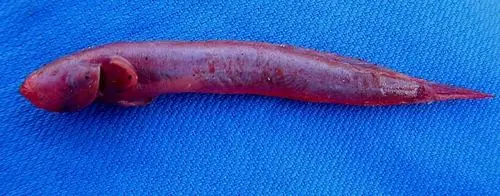
Cá Bống thụt dài

Brachyamblyopus urolepis (Bleeker, 1852)

WoRMS — Tên cũ — đã được cập nhật
Tên hiện hành: Caragobius urolepis
Xem trên WoRMS (marinespecies.org)

Thông tin chính

Tên gọi khác
Den sông
Common Name (EN)
scaleless worm goby
Kích thước
70 - 80mm.
Size
70 - 80mm.

Phân bố

Ấn Độ, Andaman, Thái Lan, Indonesia, Philippin, Việt Nam. Vịnh Bắc Bộ.

Mẫu vật & Tài liệu

Nơi lưu trữ mẫu
Phân Viện Hải Dương Học Hải Phòng.
Specimen
Haiphong Branch of Institute of Oceanography.
Tình trạng
Ít gặp.
Status
Uncommon.
Tài liệu dẫn
Koumans, 1953, Nguyễn Nhật Thi, 1991.
Literature
Koumans, 1953, Nguyen Nhat Thi, 1991.

Sinh học — Sinh thái BIO

Sách Đỏ IUCN
LC
IUCN Red List
LC

Ghi chú chi tiết

Morphological description (GBIF)(Mô tả hình thái (GBIF))

Description. As for genus except as follows. Total elements in dorsal fin 36 - 43 (mean = 39.2); total elements in anal fin 31 - 36 (mean = 33.1), first element segmented, or segmented and branched; pectoral-fin rays 17 - 20 (mean = 18.4); anal-fin pterygiophores preceding the first hemal spine (AP) 4 - 7 (mean = 5.4); caudal vertebral count 18 - 22 (mean = 20.2); SL / TL 0.794 - 0.891 (mean = 0.824); pelvic-fin length (PEL) / HL 0.311 - 0.615 (mean = 0.494); predorsal length / SL 0.241 - 0.363 (mean = 0.287). Scales only on posterior 25 - 30 % of body, remainder of body and head lacking scales. 18 - 27 teeth on outer row of upper jaw; 12 - 28 teeth on outer row of lower jaw. Jaws terminating posteriorly at the vertical just anterior to posterior naris. Anterior nares much closer together than posterior nares. Color when fresh. No fresh specimens were available. Bleeker (1852) stated that his specimen had a greenish body with yellowish fins. Roxas and Ablan (1940) described Nudagobioides monserrati as yellowish in life. The photograph of a presumably freshly dead Brachyamblyopus (= Caragobius) urolepis in Kottelat et al. (1993) depicts a bluish gray head, a creamy white body, the pectoral-fin base blackish blue, and the fins translucent. Color in alcohol. Head and body uniformly tannish brown with translucent fins. Some specimens with a brownish black area along posterior edge of pectoral-fin base; the color derives from a prominent blood vessel. Preserved specimens were uniformly yellowish white according to Smith and Seale (1906), whereas Hora (1923) stated that the body was olivaceous gray with whitish fins. Herre (1927) said that preserved specimens of Caragobius typhlops had a bluish gray head and yellowish body, which became whitish on belly and underside of head, and yellowish gray posteriorly. Brachyamblyopus olivaceous had a dusky olive-brown body, slightly pale head, and yellowish fins (Herre, 1927). As described by Fowler (1935), Caragobius geomys was dra

Xem bản dịch tiếng Việt (tham khảo)

Danh pháp đồng nghĩa & Phân loại gốc

Amblyopus urolepis Bleeker, Nat. Tijds. Ned. Indie, Vol. 3, p. 581, 1852.
Brachyamblyopis olivaceus Herre, Monogr. 23 Bur. Sci. Manila, p. 329, 1927.
Brachyamblyopus urolepis Koumans, Mem. Indian Mus., Vol. 13, p. 299; Koumans, 1953.