
Quay lại danh sách
#58Tập 6

Cá mú sáu sọc ngang

Epinephelus sexfasciatus (Valenciennes, 1828)

WoRMS — Tên hợp lệ trên WoRMS
Tên được xác nhận · cập nhật WoRMS: 2026-09-02
Xem trên WoRMS (marinespecies.org)

Thông tin chính

Tên gọi khác
Cá Song sáu sọc ngang, Cá Song rạn sáu sọc ngang
Common Name (EN)
Halfmoon grouper
Kích thước
21,0 cm; kích thước lớn nhất 40,0 cm TL (Allen, G.R. and M.V. Erdmann, 2012).
Size
21.0 cm; maximum length 40.0 cm TL (Allen, G.R. and M.V. Erdmann, 2012).

Mô tả hình thái

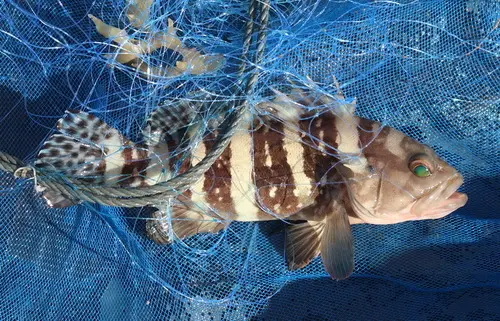
D XI. 16-18; A III. 8. Số vảy đường bên 48-53. Số lược mang dưới 14-16, số lược mang trên 6-8, tổng số lược mang 20-24. Đầu nhỏ, thân có màu nâu nhạt với đốm thưa không đều, có 5-6 dải sọc xiên màu nâu sẫm. Vây đuôi tròn, màu nâu sẫm với các đốm nhạt màu. Mép vảy sau trên cơ thể có hình răng cưa (ngoại trừ vảy trên các vùng gáy, ngực, lườn bụng và đường bên). Mép nắp mang trên thẳng, nằm gần như thẳng đứng. Răng cửa hàm trên có 2-3 hàng răng nhọn.

Sinh thái & Dinh dưỡng

Mẫu vật thường Sinh thai, an được phát hiện chủ yếu trong hệ sinh thái rạn san hô, rạn đá ngầm, ở độ sâu 2-150m; ; Ban ngày ẩn nấp trong hang; Vận động bắt mổi mồi về đêm; Thức ăn chủ yếu là cá nhỏ và động vật giáp xác; Là loài lưỡng tính, thời gian đổi giới tính từ con đực sang con cái ở giai đoạn 3+; Tu đàn trong mùa sinh sản (Sommer, C., et al, 1996).

Phân bố

Việt Nam: Nơi phát hiện mẫu vật: Đảo Trần, Ba Mùn, Cồn Cỏ, Hải Vân - Son Trà, Thổ Chu... Thế giới: Vùng biển Án Độ - Thái Bình Dương.

Giá trị kinh tế

Có giá trị cao trên thị trường thực phẩm hải sản tươi sống.

Mẫu vật & Tài liệu

Nơi lưu trữ mẫu
Không rõ
Specimen
Unknown

Sinh học — Sinh thái BIO

Ghi chú chi tiết

Morphological description (GBIF)(Mô tả hình thái (GBIF))

Phylogenetic definition. Hypsilophodon foxii, Edmontosaurus regalis, their most recent common ancestor, and all of its descendants (Norman, 2015). Unambiguous synapomorphies. For the topology recovered by parsimony, Clypeodonta has nine unambiguous synapomorphies: presence of a quadrate buttress or " hamular process " (63.1), quadrate with a lateral condyle that is larger than the medial condyle (69.2), mandibular articulation that is horizontal to dorsomedially inclined in caudal view (70.0 / 1), maxillary and dentary teeth with crowns that taper toward the root (127.1, 128.1), with the base of the crown defined by an everted lip which makes the crown slightly inset from the root (146.1, 147.1), presence of a primary ridge on labial side of maxillary teeth (139.1), and elongate centra of postaxial cervical vertebrae, with craniocaudal length more than twice the dorsoventral height (159.1). Within the Bayesian topology, Clypeodonta is characterized primarily by features of the teeth and jaws: presence of a diastema in the maxilla (16.1), equal lengths in the oral margin of the premaxilla and predentary (84.1), a coronoid process that extends more than one crown height dorsal to the tooth row (101.1), surangular with a small fenestra positioned dorsally on or near the dentary joint (111.1), surangular foramen rostral to the lateral lip of the glenoid (114.1), cheek teeth with asymmetrically distributed enamel (134.1), ridges running the full length of the crown on the labial side of maxillary teeth and the lingual side of dentary teeth (135.1), and a femoral head separated from the greater trochanter by a distinct constriction (292.1). Topology. In the parsimony tree (Figures 6, 7), Clypeodonta is the sister clade to Thescelosauridae. This node has a jackknife value of 15, but a relatively high Bremer support of 4. Hypsilophodon is recovered as the only non-iguanodontian clypeodontan. In the Bayesian topology (Figures 6, 8), Hypsilophodon is recovered within a large

Xem bản dịch tiếng Việt (tham khảo)

Chưa có danh pháp đồng nghĩa.